The expansion of Pharmacy First has been one of the most significant changes to community pharmacy practice in recent years. Pharmacists are increasingly being asked to assess patients, identify red flags, make treatment decisions and determine when patients can be managed within pharmacy or need to be referred elsewhere.
With that increased clinical responsibility comes another requirement that receives considerably less attention: the quality of the clinical record that sits behind each decision.
NHS England’s recently published Pharmacy Quality Scheme (PQS) 2026/27 Clinical Services Audit for Pharmacy First clinical pathway consultations brings this issue firmly into focus. The audit examines the quality and completeness of Pharmacy First consultation records across all seven clinical pathways and sets a 100% standard for each of the seven record elements being assessed.
On the surface, this may appear to be another documentation requirement. In reality, it points towards something much more significant about the direction in which community pharmacy is moving.
It is no longer enough to record that a consultation happened
A good Pharmacy First consultation record needs to allow another healthcare professional to understand what happened during the consultation and why the pharmacist reached the decision they did.
NHS England’s audit therefore considers whether the record contains important information about the patient’s eligibility for the relevant pathway, the assessment undertaken, the clinical findings recorded, the rationale behind the treatment decision and the safety-netting advice provided to the patient. Safeguarding and other aspects of the clinical record also form part of the wider audit criteria.
These are not simply administrative details. Taken together, they provide an account of the pharmacist’s clinical reasoning.
There is an important difference between recording that an outcome occurred and documenting how that outcome was reached. A record stating that an antibiotic was supplied, for example, tells us what happened. A record containing the patient’s presenting symptoms, relevant assessment findings, pathway criteria, red flags considered, treatment rationale and safety-netting provides the clinical context necessary to understand why that decision was appropriate.
As pharmacists take on increasingly complex clinical responsibilities, that distinction becomes much more important.
Pharmacy is moving from transactional records to clinical records
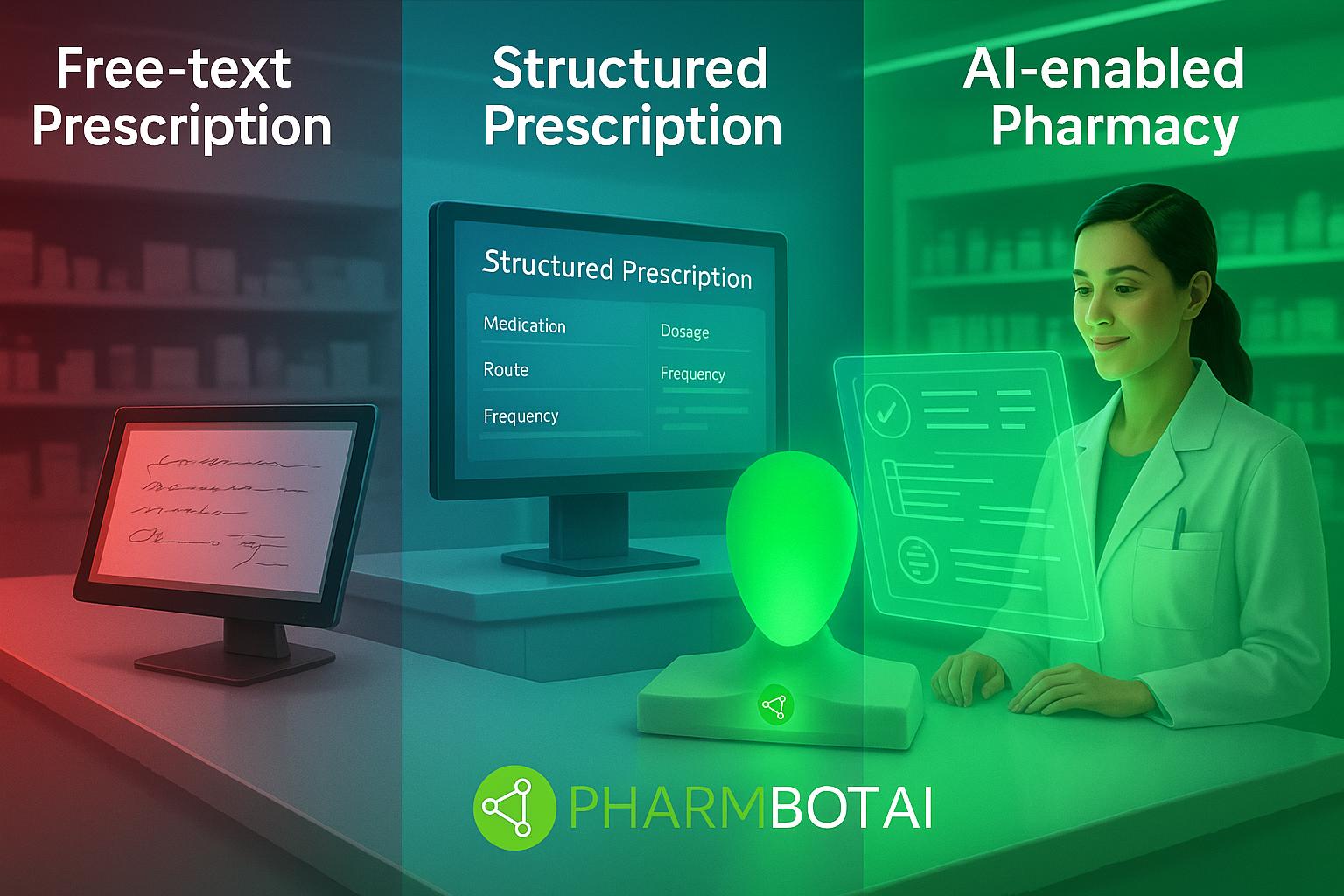
Much of the technology traditionally used in community pharmacy has understandably developed around dispensing. Systems have been very good at recording transactions: prescriptions received, medicines supplied, services completed and claims submitted.
Pharmacy First represents a different type of activity. A pharmacist may now be assessing a patient presenting with symptoms, reviewing relevant medical information, applying a clinical pathway, considering exclusion criteria, identifying potential deterioration and deciding whether treatment, self-care or onward referral is appropriate.
That is a clinical decision-making process rather than simply a transaction, and the technology supporting it therefore needs to capture a different type of information.
The clinical record needs to tell the story of the consultation in a way that another healthcare professional could understand and, where necessary, safely rely upon when continuing the patient’s care.
This becomes even more important when considered alongside the wider changes taking place within the profession. From September 2026, newly qualified pharmacists joining the GPhC register will do so as independent prescribers, while NHS England has also outlined the continued development of prescribing services within community pharmacy.
As the profession gains greater clinical autonomy, the infrastructure surrounding pharmacists will need to support greater clinical accountability. Good documentation is an essential part of that accountability.
Documentation should be created during the consultation, not after it
One of the challenges with clinical documentation is that it can easily become an additional administrative task. The pharmacist conducts the consultation, reaches a decision and then has to recreate the reasoning behind that decision in a separate record.
That approach creates unnecessary workload and increases the possibility that clinically relevant information will be omitted, particularly in a busy community pharmacy environment.
There is a better way to think about the problem. Instead of treating documentation as something that happens after the clinical workflow, the documentation can be generated naturally through the workflow itself.
If a consultation is structured around establishing eligibility, recording symptoms and clinical findings, checking red flags and exclusion criteria, documenting the treatment decision and rationale, providing appropriate safety-netting and obtaining final pharmacist review, much of the clinical record already exists by the time the consultation is completed.
The pharmacist should not have to reconstruct the consultation afterwards because the record has been created as part of the consultation.
This is an important design principle for the next generation of pharmacy technology.
What this means for AI in community pharmacy
The same principle has implications for the way artificial intelligence is introduced into pharmacy practice.
There is considerable interest in what AI can tell healthcare professionals: what it can summarise, what questions it can answer and what recommendations it might generate. Those capabilities are useful, but they address only part of the problem.
The more important question is how AI fits safely into the clinical workflow.
An AI system that sits outside the consultation may provide useful information, but it can also create another system for the pharmacist to interact with. Information may still need to be transferred between systems, the consultation still needs to be documented and the pharmacist still needs to establish a clear clinical record explaining the final decision.
For AI to become genuinely useful in frontline pharmacy practice, it needs to support the clinical process rather than simply sit alongside it. That means helping to structure information, identifying where relevant information may be missing, supporting consistent documentation and presenting information in a way that assists the pharmacist while preserving human clinical judgement.
Crucially, the pharmacist must remain responsible for the final decision. AI can support the process, but accountability cannot simply be transferred to an algorithm.
How this relates to PharmBot AI
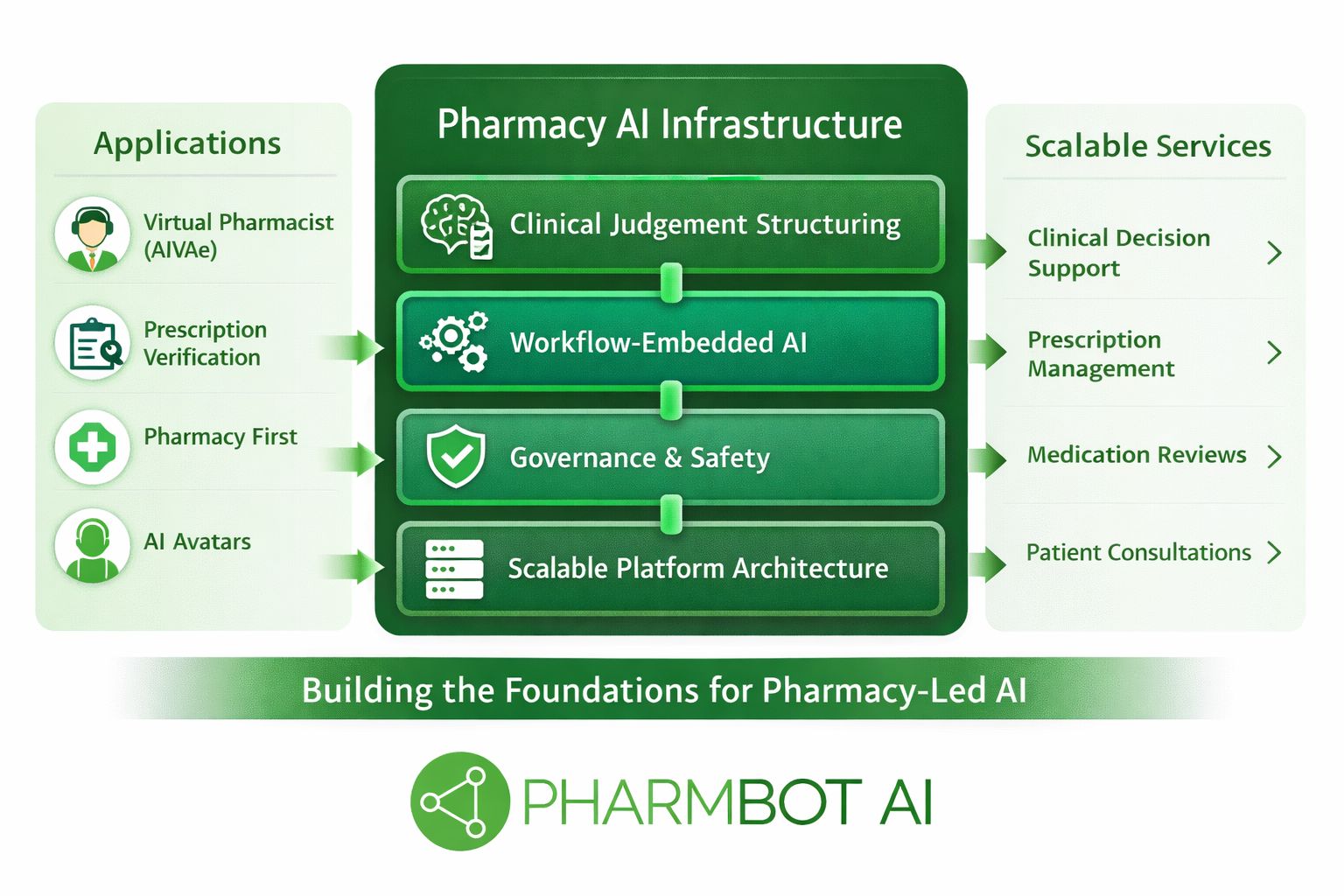
This is the problem that has shaped the development of PharmBot AI and AIVAe.
Rather than building an AI chatbot and then trying to insert it into pharmacy practice, our approach has been to start with the pharmacy workflow itself. For Pharmacy First, that means looking at how a consultation progresses from initial eligibility and assessment through clinical reasoning, treatment decisions, safety-netting and final pharmacist review.
The aim is for the clinical record to emerge from that process rather than requiring the pharmacist to create it separately afterwards.
Our Pharmacy First module is therefore being developed to support structured consultations while capturing the information needed to produce a meaningful clinical record. The pharmacist reviews the information, applies their professional judgement and remains responsible for the final clinical decision, while the technology supports the structure and documentation surrounding that decision.
The significance of the new NHS England audit for us is not that it suddenly creates this problem. The problem already existed. What the audit does is make the importance of high-quality, auditable Pharmacy First documentation much more explicit.
It also reinforces an argument we have made throughout the development of PharmBot AI: healthcare AI is unlikely to achieve its potential if it is simply bolted onto existing clinical systems. It needs to be designed around the realities of clinical practice, including workflow, accountability, documentation, governance and human oversight.
The next phase of Pharmacy First
The Pharmacy First audit should therefore be viewed in the context of the wider transformation taking place across community pharmacy.
The first phase of that transformation has been about expanding what pharmacists can do. The next phase will increasingly be about demonstrating how those clinical decisions are made, ensuring that the records supporting them are complete and enabling those records to form part of a patient’s wider continuity of care.
That creates challenges for pharmacy teams, particularly when workload pressures are already considerable. But it also creates an opportunity to rethink the technology supporting clinical pharmacy services.
The objective should not be to give pharmacists another form to complete or another system to manage. It should be to design systems in which good clinical documentation is a natural consequence of delivering good clinical care.
NHS England’s latest Pharmacy First audit is an important signal in that direction. As community pharmacy assumes greater clinical responsibility, the quality of the record behind each consultation will become increasingly important.
The future of Pharmacy First will not simply be measured by how many consultations pharmacies deliver. It will also depend on whether the clinical record can clearly demonstrate what was assessed, why a decision was made and how the patient was advised and managed.
For pharmacy technology, that is a very different design challenge — and one that we believe needs to be addressed now.
Source: NHS England, Pharmacy Quality Scheme 2026/27: Clinical Services Audit – Pharmacy First Clinical Pathways Consultations, published 26 August 2026.