Category: Blog

  • Advancing Responsible AI in Pharmacy: How PharmBot AI is Applying the Global Playbook

    Advancing Responsible AI in Pharmacy: How PharmBot AI is Applying the Global Playbook

    In September 2025, the World Economic Forum’s AI Governance Alliance, in collaboration with Accenture, released a landmark report: Advancing Responsible AI Innovation: A Playbook.

    This playbook is not regulation. It is something far more practical: a global handbook of nine “plays” that organisations can use to ensure their AI innovations are safe, transparent, and sustainable. From anchoring AI to clear purpose, to embedding governance, transparency, and human-centred design, it provides a practical roadmap for responsible adoption.

    At PharmBot AI, we believe this matters deeply to pharmacy. Unlike other industries, trust in healthcare is non-negotiable. If pharmacists and patients do not have confidence in how AI makes recommendations, adoption will stall — no matter how powerful the technology may be.

    What the Playbook Means for AIVAe

    Our flagship solution, AIVAe, is being built to align with the playbook’s guidance. Here is how the nine plays translate into practice:

    • Purpose-driven: AIVAe’s mission is clear — to support pharmacists in delivering safer, more efficient care, freeing up their time for patients.
    • Governance-first: We are establishing oversight processes, escalation pathways, and aligning development with UK frameworks such as the MHRA AI-Airlock and NHS AI Lab guidance.
    • Lifecycle responsibility: Risk assessments and safety checks are built into design, deployment, and monitoring stages.
    • Human-centred design: Co-created with pharmacists and patients, ensuring usability and accessibility.
    • Transparency and explainability: Every clinical recommendation is backed by authoritative sources (BNF, NICE, MHRA) and fully auditable.
    • Continuous monitoring: Automated alerts for drug updates, safety issues, or bias detection.
    • Skills and culture: Through the planned AIVAe Training Academy, pharmacists and technicians will gain confidence in responsible AI use.
    • Partnerships and standards: We are working with NHS bodies, regulators, and digital health networks to align with open standards.
    • Iteration and adaptation: AIVAe’s roadmap anticipates regulatory change and will evolve to meet the highest standards of responsible AI.

    Why This Matters

    Pharmacy is on the front line of medicines safety. From dispensing controlled drugs such as morphine, to managing high-volume workflows, the risks of error are real and consequential. By embedding responsibility into the DNA of AIVAe, we are ensuring that innovation does not come at the expense of safety — instead, it enhances it.

    The Responsible AI Playbook reinforces what we have always believed: that innovation and responsibility must advance together. AIVAe is our commitment to showing how a UK-born pharmacy AI system can meet global standards of trust, safety, and accountability.

    📌 Next steps: We will be sharing updates on how we are embedding these principles into AIVAe’s upcoming release. Watch this space.

    #ResponsibleAI #Pharmacy #DigitalHealth #Innovation #PharmBotAI #AIVAe

  • The Future of Healthcare AI Regulation: What It Means for Community Pharmacy

    The Future of Healthcare AI Regulation: What It Means for Community Pharmacy

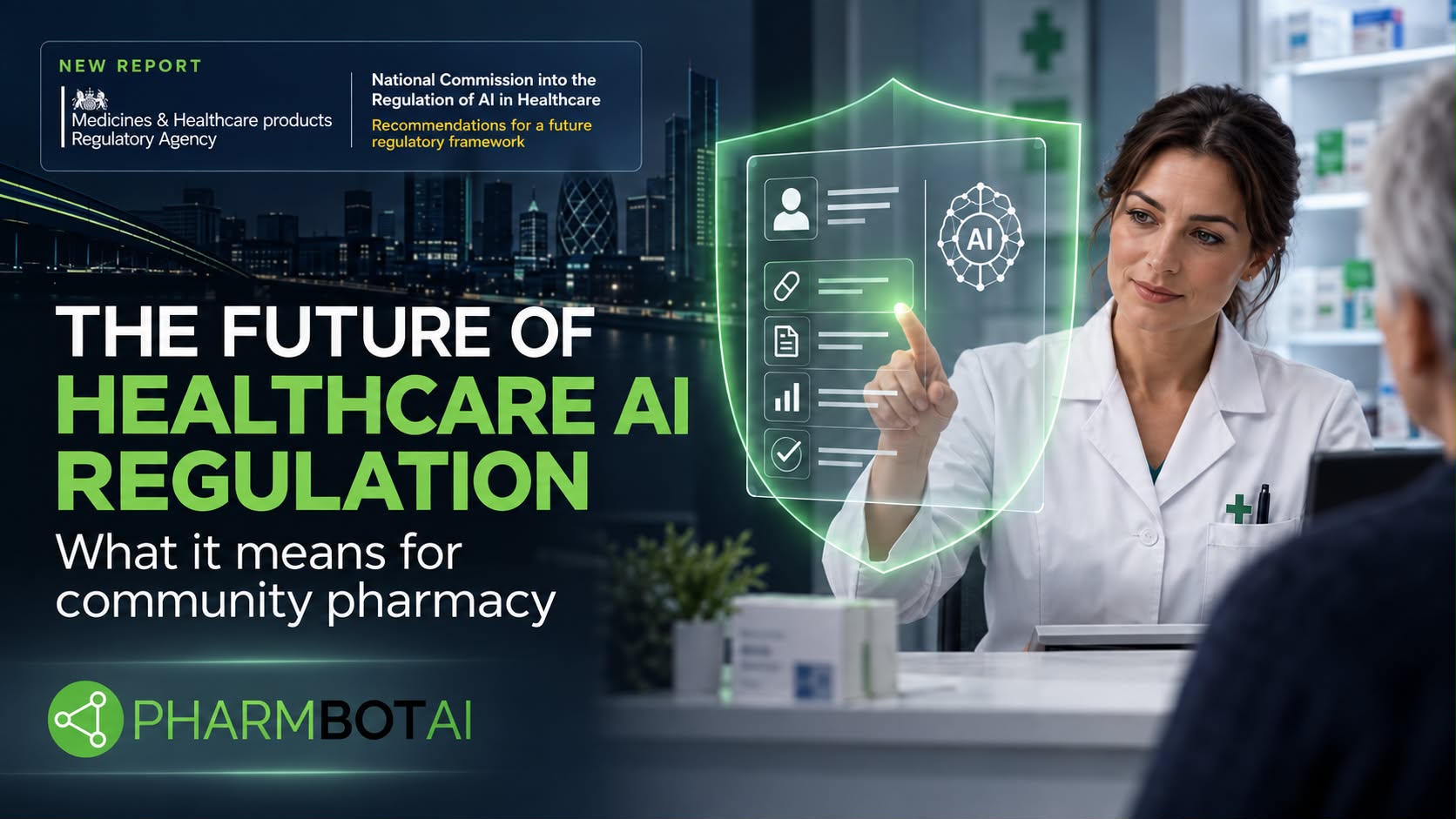
    The National Commission into the Regulation of AI in Healthcare has outlined a future in which healthcare AI is introduced through staged authorisation, continuous monitoring, transparency and meaningful human oversight. For community pharmacy, these recommendations arrive at a pivotal moment.

    Artificial intelligence is moving rapidly from experimental healthcare projects into everyday clinical workflows. Its ability to analyse information, structure consultations and support clinical decisions is advancing—but technical capability alone will not secure adoption.

    Healthcare AI must also earn the confidence of patients, clinicians, regulators and the public.

    The independent National Commission into the Regulation of AI in Healthcare, established by the Medicines and Healthcare products Regulatory Agency (MHRA), has now published recommendations intended to strengthen the regulation of healthcare AI while supporting its safe adoption.

    The Commission gathered evidence from more than 12,000 patients, clinicians, healthcare leaders, industry experts and members of the public. Its recommendations indicate how the United Kingdom may approach the next stage of healthcare AI regulation.

    From one-off approval to continuous assurance

    Traditional medical-device regulation has generally focused on assessing a product before it enters the market. AI creates a more complex challenge.

    An AI-enabled system may be updated, encounter new patient populations or perform differently when introduced into real clinical environments. Its safety and effectiveness cannot necessarily be established through a single assessment at one point in time.

    The Commission has therefore recommended continuous, real-world monitoring of AI-enabled medical devices throughout their operational life.

    This represents an important change in regulatory thinking. Approval should not be viewed as the end of the safety process. Developers and healthcare organisations will need to understand how an AI system performs after deployment, identify emerging risks and demonstrate that appropriate action is taken when problems occur.

    For AI developers, this means building monitoring, auditability, incident reporting and change control into the product from the beginning.

    Staged authorisation for healthcare AI

    One of the Commission’s most notable recommendations is a system of staged authorisation for new AI models.

    The Commission compares this approach to learner-driver arrangements: an AI system could be permitted to operate within carefully defined restrictions while evidence is gathered through supervised, real-world use. Greater freedom could then be granted as the system demonstrates an acceptable level of safety and performance.

    This could provide a more practical route between laboratory testing and unrestricted deployment.

    Healthcare environments are complex, and controlled pilots can reveal risks that may not be apparent during technical development. However, pilots must have clearly defined boundaries, named clinical responsibility, escalation procedures and measurable safety outcomes. A pilot should not simply be an informal deployment under another name.

    For community pharmacy, staged authorisation could support carefully controlled testing of AI within selected pharmacies, clinical pathways or patient groups while pharmacists retain responsibility for the final decision.

    Transparency must become a practical requirement

    The Commission also recommends public access to safety information about specific AI-enabled medical devices, including information about adverse incidents.

    Patients are increasingly prepared to accept AI as part of their care, but that acceptance depends on knowing when it is being used, what role it plays and who remains responsible for the outcome.

    Transparency cannot be reduced to a statement hidden within lengthy terms and conditions. It must be understandable and meaningful.

    Patients should be able to distinguish between an AI system that structures information, one that makes recommendations and one that materially influences a diagnosis or treatment decision. They should also know when a healthcare professional reviews the system’s output and how concerns can be raised.

    Responsible transparency is not a barrier to adoption. It is one of the conditions that makes adoption possible.

    Why this matters for community pharmacy

    Community pharmacy is assuming a larger clinical role within the NHS.

    Through Pharmacy First and other commissioned services, pharmacists are assessing symptoms, applying clinical pathways, determining treatment eligibility, supplying medicines and providing safety-netting advice. This creates an important opportunity for AI to help structure consultations, identify missing information and support consistent clinical documentation.

    It also creates risk if AI is introduced without adequate governance.

    A system used within a pharmacy consultation may influence decisions about treatment, referral or urgent escalation. Its performance must therefore be considered in the context of the complete clinical workflow—not simply as a standalone algorithm.

    Several questions become essential:

    • What is the system’s intended clinical purpose?
    • What information does it use?
    • How are recommendations generated and presented?
    • Can the pharmacist challenge or override the output?
    • How are omissions, errors and safety incidents identified?
    • How are model or system changes controlled?
    • Does performance remain consistent across different patient groups?
    • What information is recorded for later audit?
    • Is the patient told that AI is being used?

    These are not abstract regulatory questions. They affect how AI should be designed, purchased and used inside pharmacies.

    Human oversight must be meaningful

    The Commission’s emphasis on human oversight is especially relevant to pharmacy.

    Simply placing a healthcare professional somewhere within the process does not automatically make an AI system safe. Oversight must be meaningful.

    The pharmacist must have sufficient information to evaluate the AI output, the authority to reject it and enough time to exercise independent professional judgement. The interface should make uncertainty, limitations and missing information visible rather than presenting every recommendation with the same level of confidence.

    Responsibility must also be clearly allocated. Pharmacists, pharmacy owners, technology suppliers and healthcare commissioners should understand their respective roles when an AI-supported decision contributes to patient harm.

    The objective should not be to replace professional judgement. It should be to make that judgement better informed, more consistent and more auditable.

    Designing for the regulatory direction of travel

    The Commission’s recommendations are not yet legislation. The government and the MHRA will consider them before issuing a formal response.

    Nevertheless, they provide a clear indication of the likely direction of travel.

    Healthcare AI developers should prepare for an environment in which evidence continues to be collected after deployment, safety information becomes more visible and regulators expect stronger controls over system updates and real-world performance.

    At PharmBot AI, these principles are central to the development of AIVAe. The platform is being designed around structured clinical support, auditable decision-making and pharmacist oversight throughout the consultation.

    This is not only a question of regulatory readiness. It is about creating technology that pharmacists can use responsibly and that patients can trust.

    Trust will determine which systems scale

    The next phase of healthcare AI will not be defined only by which system appears most intelligent.

    It will be defined by which systems can demonstrate a clear purpose, appropriate clinical oversight, reliable performance, transparent limitations and continuous evidence of safety.

    For community pharmacy, the opportunity is substantial. AI could help pharmacists manage increasing clinical responsibility while improving consistency, documentation and access to care. But adoption must be supported by governance that reflects the realities of frontline practice.

    The Commission’s recommendations bring the UK closer to a regulatory model capable of supporting both innovation and accountability.

    That balance will ultimately determine whether healthcare AI remains a collection of promising experiments—or becomes trusted clinical infrastructure.

    Read the full report:
    https://assets.publishing.service.gov.uk/media/6aa01a2d62ec7fe7bedf517a/Full_National_Commission_Report_-_Publication.pdf

  • The Hidden Burden of Pharmacy First –  What No One Is Talking About

    Pharmacy First is the right policy – but the wrong conversation

    Pharmacy First is one of the most significant shifts in community pharmacy in a generation. It formally recognises what pharmacists have been doing for years: delivering accessible, front-line clinical care.

    On paper, it’s a win for patients, pharmacists, and the NHS.

    But on the ground, a quieter reality is emerging, one that isn’t being discussed openly enough.

    Pharmacy First isn’t failing because pharmacists lack capability or motivation.
    It’s struggling because the operational and cognitive burden placed on pharmacies has been underestimated.

    And unless that burden is addressed, Pharmacy First risks becoming another well-intentioned service that never fully scales.

    The burden isn’t clinical – it’s infrastructural

    Most commentary focuses on clinical pathways, inclusion criteria, and remuneration. Those matter  but they are not the core problem.

    The real burden sits elsewhere:

    • Cognitive load during consultations
    • Fragmented workflows across multiple systems
    • Documentation pressure under time constraints
    • Clinical accountability without proportional support
    • Audit anxiety in a heavily regulated environment

    Pharmacists are being asked to deliver more clinical services, at higher frequency, with the same physical infrastructure and largely the same digital one.

    That mismatch is where friction appears.

    What a Pharmacy First consultation actually looks like

    In reality, a Pharmacy First consultation is not a simple checklist exercise.

    A pharmacist must simultaneously:

    • Interpret eligibility and red-flag criteria
    • Apply PGDs accurately
    • Maintain clinical judgement
    • Document decisions defensibly
    • Manage time pressure
    • Protect patient safety
    • Remain audit-ready

    All while working in busy, interruption-heavy environments.

    This is complex clinical cognition, compressed into short appointment windows.

    The policy acknowledges this complexity.
    The infrastructure largely does not.

    Why adding “tools” isn’t enough

    Most digital responses to Pharmacy First have focused on tools:

    • Templates
    • Forms
    • Checklists
    • Standalone apps

    These help  but they don’t solve the underlying issue.

    Tools still require the pharmacist to:

    • Remember what applies
    • Interpret guidance in real time
    • Carry the full cognitive and legal load
    • Context-switch repeatedly between systems

    In other words, tools digitise paperwork, they don’t reduce burden.

    What’s missing is something deeper.

    The missing layer: clinical AI infrastructure

    Pharmacy First doesn’t need more apps.
    It needs clinical infrastructure that sits underneath services and supports them safely.

    That infrastructure should:

    • Embed clinical logic into workflows
    • Surface relevant guidance at the point of care
    • Maintain human-in-the-loop control
    • Create defensible audit trails automatically
    • Preserve pharmacist ownership of decisions

    This is not about replacing pharmacists.

    It’s about supporting clinical judgement at scale without increasing risk.

    Why this matters for safety, not just efficiency

    When cognitive load rises, risk rises with it.

    Not because pharmacists are careless  but because humans operating under sustained pressure are more vulnerable to error.

    If Pharmacy First is to expand safely:

    • Across more conditions
    • Across more pharmacies
    • Across more patients

    Then risk must be managed structurally, not informally.

    Clinical AI infrastructure allows:

    • Consistency without rigidity
    • Support without automation creep
    • Oversight without surveillance

    Done correctly, it reduces both clinical risk and professional anxiety.

    What this enables next

    If the right infrastructure is in place, Pharmacy First becomes a foundation not a ceiling.

    It enables:

    • Faster onboarding of new services
    • More consistent national delivery
    • Better outcome measurement
    • Stronger commissioning confidence
    • Future integration with prescribing, diagnostics, and referrals

    Without it, every new service adds friction rather than momentum.

    A quiet truth worth saying out loud

    Pharmacists are not resisting Pharmacy First.

    They are absorbing its weight.

    And many are doing so silently, because professionalism often looks like coping.

    If we want Pharmacy First to succeed long-term, we must stop asking pharmacists to carry system-level complexity alone.

    The solution is not more resilience.  It’s better infrastructure.

    About PharmBot AI

    PharmBot AI is building clinically governed AI infrastructure designed specifically for pharmacy – supporting services like Pharmacy First while preserving safety, accountability, and professional ownership.

    Not as a chatbot.

    Not as a shortcut.

    But as infrastructure fit for regulated clinical care.

  • The Pharmacy of 2030: From Dispensing Centre to Intelligent Clinical Hub

    By Asif Mukhtar
    Founder & CEO (Consultant Pharmacist), PharmBot AI

    Introduction: The Reality We Must Confront

    Community pharmacy in 2026 is clinically capable but operationally constrained.

    Pharmacists are delivering more services than ever before — from Pharmacy First consultations to independent prescribing pathways — yet the infrastructure underpinning this expansion remains fragmented.

    • Manual documentation.
    • Disconnected digital systems.
    • Repetitive cognitive workload.
    • Inconsistent triage processes.
    • Limited real-time outcomes reporting.

    The ambition for pharmacy is growing. The digital architecture supporting it is not.

    If community pharmacy is to become a true front-door clinical service by 2030, the transformation required is not cosmetic. It is infrastructural.

    The pharmacy of 2030 will not simply look different.

    It will think differently.

    From Dispensing Volume to Clinical Intelligence

    For decades, community pharmacy has been structurally designed around volume dispensing. Clinical services were layered on top of an operational model built for product throughput.

    By 2030, this model will be inverted.

    Dispensing will increasingly be automated — whether through centralised hub models, robotic systems, or intelligent stock management. The pharmacist’s value will shift decisively toward:

    • Clinical assessment
    • Independent prescribing
    • Medicines optimisation
    • Chronic disease support
    • Preventative health interventions

    But clinical expansion cannot rely solely on human capacity. The cognitive load involved in consultation, documentation, safety checks, guideline interpretation, and audit compliance is already substantial.

    Artificial intelligence will not replace pharmacists.

    It will reduce cognitive friction.

    AI as Clinical Co-Pilot, Not Replacement

    The dominant narrative around AI in healthcare is either hype or fear. Neither is helpful.

    In reality, the most impactful application of AI in pharmacy will be as a regulated clinical co-pilot.

    By 2030, the consultation journey may look like this:

    1. Structured AI Triage
      Patients complete structured digital assessments aligned to national service specifications.
    1. Real-Time Clinical Support
      AI surfaces relevant red flags, NICE-aligned decision prompts, contraindications, and interaction alerts during the consultation.
    1. Automated Documentation
      Consultation records are generated in structured formats, reducing manual entry time while preserving full pharmacist oversight
    1. Integrated Safety Checks
      Every decision is logged, auditable, and reviewable — ensuring accountability remains with the pharmacist.

    The pharmacist remains in control.

    The AI enhances consistency and reduces variation.

    This is augmentation — not automation of responsibility.

    The Physical Environment of 2030

    The pharmacy of 2030 will likely feel different.

    • Robotic dispensing systems will handle high-volume items.
    • Automated stock analytics will predict demand based on local population data.
    • Digital dashboards will display service performance metrics in real time.
    • Consultation rooms will function as structured clinical environments rather than ad hoc spaces.

    However, the visible hardware is not the most important shift.

    The true transformation will sit beneath the surface.

    An intelligence layer connecting workflow, governance, documentation, and reporting.

    Without that layer, robotics and automation remain isolated tools.

    With it, pharmacy becomes an integrated clinical hub.

    Governance Will Define the Winners

    The difference between speculative AI and deployable AI in NHS pharmacy settings will not be capability — it will be governance.

    By 2030, any AI infrastructure supporting pharmacy services must demonstrate:

    • Clinical safety case alignment (DCB0129 / DCB0160 principles)
    • Structured risk assessment frameworks
    • Full audit trails
    • Role-based access control
    • Transparent decision support logic
    • Data protection compliance aligned with UK GDPR
    • NHS DTAC-level assurance readiness

    AI that cannot evidence governance will not scale in NHS environments.

    This is the fundamental shift the sector must understand.

    Innovation without assurance will not survive scrutiny.

    Data as an Outcome Asset

    One of the most underutilised assets in community pharmacy today is structured service data.

    By 2030, pharmacies will be expected to demonstrate:

    • Clinical outcome measures
    • Service utilisation trends
    • Population health contributions
    • Prescribing pattern insights
    • Safety event reporting transparency

    ICBs will increasingly require outcome visibility, not just activity reporting.

    AI-enabled infrastructure can transform consultation data into structured, analysable outputs in real time — enabling:

    • Local service optimisation
    • Workforce planning
    • Predictive demand modelling
    • Strategic commissioning conversations

    This moves pharmacy from reactive service provider to data-informed healthcare partner.

    The Infrastructure Layer: The Missing Piece

    Robotics companies will build dispensing hardware.
    Electronic prescribing providers will manage transactional flows.
    Wholesalers will optimise supply chains.

    But the intelligence layer connecting:

    • Clinical workflow
    • Structured triage
    • Safety oversight
    • Documentation
    • Compliance reporting
    • Outcome dashboards

    … remains largely underdeveloped in community pharmacy.

    The pharmacy of 2030 will require an operating system for clinical services.

    An AI-enabled, pharmacist-governed infrastructure layer that standardises how consultations are structured, recorded, supported, and audited.

    Without this layer, digital tools remain fragmented.

    With it, pharmacy can scale safely.

    What This Means for Today

    2030 is not far away.

    Pharmacies preparing for that future must begin asking:

    • How structured are our consultation processes?
    • How reproducible are our clinical decisions?
    • How visible are our safety controls?
    • How accessible are our service data insights?
    • How resilient is our digital governance framework?

    Incremental adaptation will not be sufficient.

    The shift required is architectural.

    A Vision Grounded in Practice

    The pharmacy of 2030 is not a science-fiction concept.

    It is the natural evolution of:

    • Expanding independent prescribing roles
    • Increasing service commissioning
    • Growing public reliance on community pharmacy
    • Escalating digital expectations across healthcare

    The challenge is not whether AI will influence pharmacy.

    It is whether pharmacy will shape how AI is implemented.

    If pharmacists lead the design of infrastructure — embedding governance, safety, and professional oversight — AI will strengthen the sector.

    If not, solutions will be imposed externally.

    Conclusion: From Possibility to Responsibility

    The pharmacy of 2030 will be:

    • Clinically empowered
    • Digitally structured
    • Operationally efficient
    • Governance-aligned
    • Data-informed

    The pharmacist will remain central.

    But the systems surrounding them will be intelligent, connected, and auditable.

    The transformation ahead is not about replacing professionals.

    It is about removing inefficiencies that prevent them from practicing at the top of their licence.

    The future of pharmacy will not be defined by robotics alone.

    It will be defined by the infrastructure that governs how intelligence is deployed.

    And the time to build that infrastructure is now.

  • What Building AI for Pharmacy in the UK Has Taught Me About Innovation

    In July, I will begin the Qatar Science & Technology Park (QSTP) Incubation Programme as part of the next stage of PharmBot AI’s journey.

    As I prepare for this opportunity, I have found myself reflecting on the lessons learned from developing AI solutions within community pharmacy in the United Kingdom.

    When I first started PharmBot AI, like many founders, I was focused on technology. Artificial intelligence was advancing rapidly, large language models were emerging, and there was enormous excitement about what AI could achieve in healthcare.

    The assumption seemed straightforward: build powerful technology and healthcare organisations will adopt it.

    The reality proved far more complex.

    Over the past few years, I have spent countless hours speaking with pharmacists, patients, healthcare professionals, regulators, academics, and technology leaders. What became increasingly clear was that technology is rarely the biggest challenge.

    The challenge is understanding how healthcare actually works.

    Healthcare systems are built around people, processes, regulations, cultures, funding models, and clinical responsibilities. Even the most advanced technology will struggle if it does not fit naturally into the way healthcare is delivered.

    This has been one of the most important lessons from developing PharmBot AI.

    Innovation is not simply about creating new technology.

    Innovation is about solving real problems.

    As a pharmacist, I have always believed that healthcare innovation should begin with the needs of patients and healthcare professionals. Technology should support clinical practice, not dictate it.

    This philosophy has shaped the development of PharmBot AI and influenced many of the ideas explored in my recent book, Built in the Wrong Place: AI Isn’t Failing in Healthcare — It’s Built in the Wrong Place.

    The central argument of the book is that many healthcare technology projects fail because they focus on the technology before fully understanding the environment in which it will operate.

    The result is often impressive solutions searching for a problem.

    As I begin this new chapter with QSTP, I am taking that lesson with me.

    Qatar has invested significantly in healthcare, research, innovation, and artificial intelligence. It is home to world-class institutions and an ambitious vision for the future. Rather than making assumptions about where technology is needed, I believe the first responsibility is to listen, learn, and understand.

    I want to understand how pharmacy services are delivered.

    I want to understand the challenges faced by healthcare professionals.

    I want to understand where patients experience friction within the healthcare system.

    Most importantly, I want to understand where innovation can create meaningful value.

    The experience gained from building PharmBot AI in the UK provides a foundation, but every healthcare system is unique. What works in one country may not work in another. True innovation requires humility, curiosity, and a willingness to challenge assumptions.

    The goal is not to introduce technology for the sake of innovation.

    The goal is to identify opportunities where technology can improve patient outcomes, enhance healthcare services, support healthcare professionals, and contribute to the broader healthcare ecosystem.

    Over the coming months, I look forward to engaging with pharmacists, clinicians, researchers, entrepreneurs, policymakers, and healthcare leaders across Qatar.

    The future of healthcare will not be built by technology alone.

    It will be built through collaboration, understanding, and a shared commitment to solving the challenges that matter most.

    For me, that is where innovation begins.

    Asif Mukhtar

    Founder & CEO (Consultant Pharmacist)

    PharmBot AI

  • Pharmacy First: Why the Clinical Record Is Becoming as Important as the Consultation

    Pharmacy First: Why the Clinical Record Is Becoming as Important as the Consultation

    The expansion of Pharmacy First has been one of the most significant changes to community pharmacy practice in recent years. Pharmacists are increasingly being asked to assess patients, identify red flags, make treatment decisions and determine when patients can be managed within pharmacy or need to be referred elsewhere.

    With that increased clinical responsibility comes another requirement that receives considerably less attention: the quality of the clinical record that sits behind each decision.

    NHS England’s recently published Pharmacy Quality Scheme (PQS) 2026/27 Clinical Services Audit for Pharmacy First clinical pathway consultations brings this issue firmly into focus. The audit examines the quality and completeness of Pharmacy First consultation records across all seven clinical pathways and sets a 100% standard for each of the seven record elements being assessed.

    On the surface, this may appear to be another documentation requirement. In reality, it points towards something much more significant about the direction in which community pharmacy is moving.

    It is no longer enough to record that a consultation happened

    A good Pharmacy First consultation record needs to allow another healthcare professional to understand what happened during the consultation and why the pharmacist reached the decision they did.

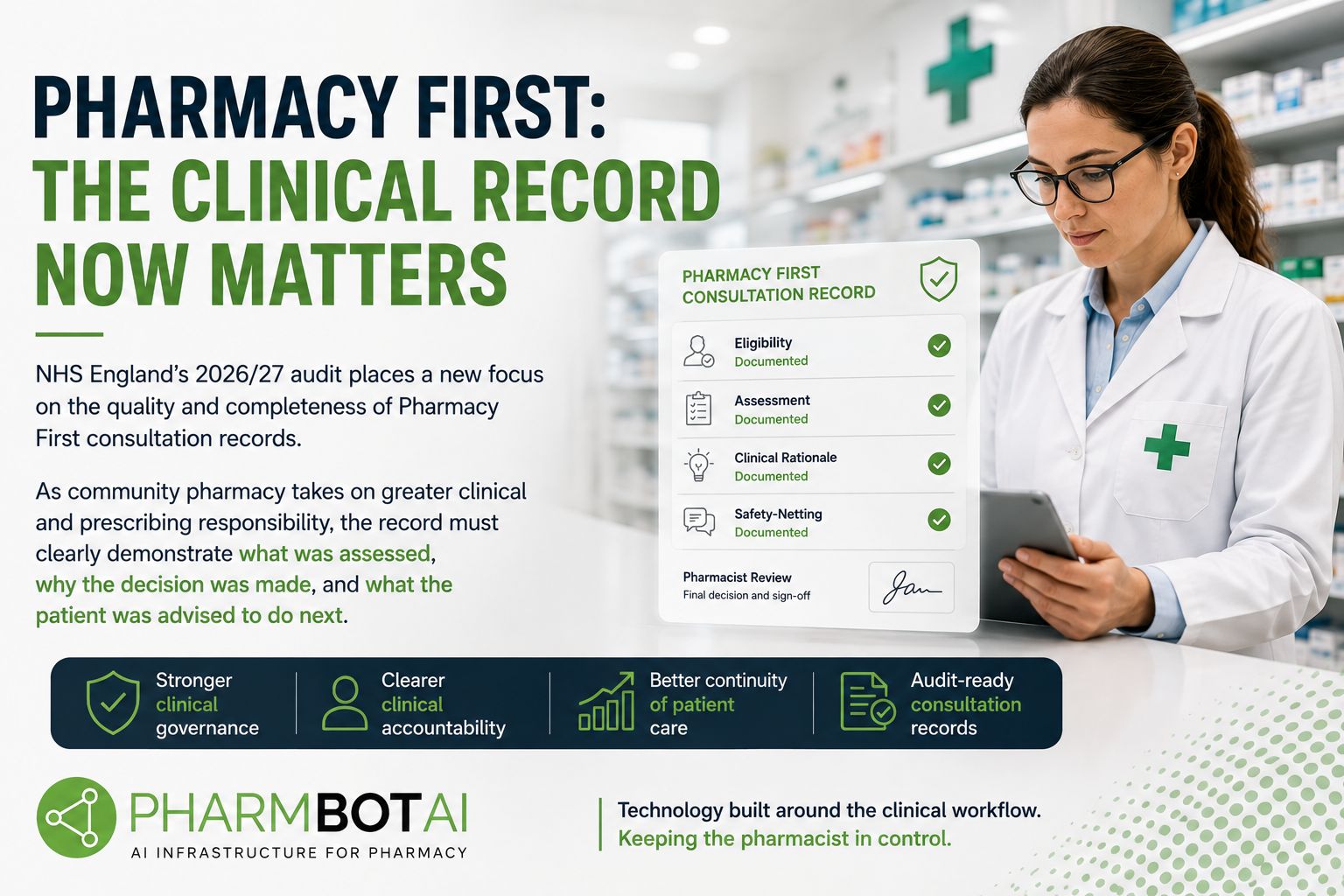
    NHS England’s audit therefore considers whether the record contains important information about the patient’s eligibility for the relevant pathway, the assessment undertaken, the clinical findings recorded, the rationale behind the treatment decision and the safety-netting advice provided to the patient. Safeguarding and other aspects of the clinical record also form part of the wider audit criteria.

    These are not simply administrative details. Taken together, they provide an account of the pharmacist’s clinical reasoning.

    There is an important difference between recording that an outcome occurred and documenting how that outcome was reached. A record stating that an antibiotic was supplied, for example, tells us what happened. A record containing the patient’s presenting symptoms, relevant assessment findings, pathway criteria, red flags considered, treatment rationale and safety-netting provides the clinical context necessary to understand why that decision was appropriate.

    As pharmacists take on increasingly complex clinical responsibilities, that distinction becomes much more important.

    Pharmacy is moving from transactional records to clinical records

    Much of the technology traditionally used in community pharmacy has understandably developed around dispensing. Systems have been very good at recording transactions: prescriptions received, medicines supplied, services completed and claims submitted.

    Pharmacy First represents a different type of activity. A pharmacist may now be assessing a patient presenting with symptoms, reviewing relevant medical information, applying a clinical pathway, considering exclusion criteria, identifying potential deterioration and deciding whether treatment, self-care or onward referral is appropriate.

    That is a clinical decision-making process rather than simply a transaction, and the technology supporting it therefore needs to capture a different type of information.

    The clinical record needs to tell the story of the consultation in a way that another healthcare professional could understand and, where necessary, safely rely upon when continuing the patient’s care.

    This becomes even more important when considered alongside the wider changes taking place within the profession. From September 2026, newly qualified pharmacists joining the GPhC register will do so as independent prescribers, while NHS England has also outlined the continued development of prescribing services within community pharmacy.

    As the profession gains greater clinical autonomy, the infrastructure surrounding pharmacists will need to support greater clinical accountability. Good documentation is an essential part of that accountability.

    Documentation should be created during the consultation, not after it

    One of the challenges with clinical documentation is that it can easily become an additional administrative task. The pharmacist conducts the consultation, reaches a decision and then has to recreate the reasoning behind that decision in a separate record.

    That approach creates unnecessary workload and increases the possibility that clinically relevant information will be omitted, particularly in a busy community pharmacy environment.

    There is a better way to think about the problem. Instead of treating documentation as something that happens after the clinical workflow, the documentation can be generated naturally through the workflow itself.

    If a consultation is structured around establishing eligibility, recording symptoms and clinical findings, checking red flags and exclusion criteria, documenting the treatment decision and rationale, providing appropriate safety-netting and obtaining final pharmacist review, much of the clinical record already exists by the time the consultation is completed.

    The pharmacist should not have to reconstruct the consultation afterwards because the record has been created as part of the consultation.

    This is an important design principle for the next generation of pharmacy technology.

    What this means for AI in community pharmacy

    The same principle has implications for the way artificial intelligence is introduced into pharmacy practice.

    There is considerable interest in what AI can tell healthcare professionals: what it can summarise, what questions it can answer and what recommendations it might generate. Those capabilities are useful, but they address only part of the problem.

    The more important question is how AI fits safely into the clinical workflow.

    An AI system that sits outside the consultation may provide useful information, but it can also create another system for the pharmacist to interact with. Information may still need to be transferred between systems, the consultation still needs to be documented and the pharmacist still needs to establish a clear clinical record explaining the final decision.

    For AI to become genuinely useful in frontline pharmacy practice, it needs to support the clinical process rather than simply sit alongside it. That means helping to structure information, identifying where relevant information may be missing, supporting consistent documentation and presenting information in a way that assists the pharmacist while preserving human clinical judgement.

    Crucially, the pharmacist must remain responsible for the final decision. AI can support the process, but accountability cannot simply be transferred to an algorithm.

    How this relates to PharmBot AI

    This is the problem that has shaped the development of PharmBot AI and AIVAe.

    Rather than building an AI chatbot and then trying to insert it into pharmacy practice, our approach has been to start with the pharmacy workflow itself. For Pharmacy First, that means looking at how a consultation progresses from initial eligibility and assessment through clinical reasoning, treatment decisions, safety-netting and final pharmacist review.

    The aim is for the clinical record to emerge from that process rather than requiring the pharmacist to create it separately afterwards.

    Our Pharmacy First module is therefore being developed to support structured consultations while capturing the information needed to produce a meaningful clinical record. The pharmacist reviews the information, applies their professional judgement and remains responsible for the final clinical decision, while the technology supports the structure and documentation surrounding that decision.

    The significance of the new NHS England audit for us is not that it suddenly creates this problem. The problem already existed. What the audit does is make the importance of high-quality, auditable Pharmacy First documentation much more explicit.

    It also reinforces an argument we have made throughout the development of PharmBot AI: healthcare AI is unlikely to achieve its potential if it is simply bolted onto existing clinical systems. It needs to be designed around the realities of clinical practice, including workflow, accountability, documentation, governance and human oversight.

    The next phase of Pharmacy First

    The Pharmacy First audit should therefore be viewed in the context of the wider transformation taking place across community pharmacy.

    The first phase of that transformation has been about expanding what pharmacists can do. The next phase will increasingly be about demonstrating how those clinical decisions are made, ensuring that the records supporting them are complete and enabling those records to form part of a patient’s wider continuity of care.

    That creates challenges for pharmacy teams, particularly when workload pressures are already considerable. But it also creates an opportunity to rethink the technology supporting clinical pharmacy services.

    The objective should not be to give pharmacists another form to complete or another system to manage. It should be to design systems in which good clinical documentation is a natural consequence of delivering good clinical care.

    NHS England’s latest Pharmacy First audit is an important signal in that direction. As community pharmacy assumes greater clinical responsibility, the quality of the record behind each consultation will become increasingly important.

    The future of Pharmacy First will not simply be measured by how many consultations pharmacies deliver. It will also depend on whether the clinical record can clearly demonstrate what was assessed, why a decision was made and how the patient was advised and managed.

    For pharmacy technology, that is a very different design challenge — and one that we believe needs to be addressed now.

    Source: NHS England, Pharmacy Quality Scheme 2026/27: Clinical Services Audit – Pharmacy First Clinical Pathways Consultations, published 26 August 2026.