Tag: Clinical AI

  • The Hidden Burden of Pharmacy First –  What No One Is Talking About

    The Hidden Burden of Pharmacy First –  What No One Is Talking About

    Pharmacy First is the right policy – but the wrong conversation

    Pharmacy First is one of the most significant shifts in community pharmacy in a generation. It formally recognises what pharmacists have been doing for years: delivering accessible, front-line clinical care.

    On paper, it’s a win for patients, pharmacists, and the NHS.

    But on the ground, a quieter reality is emerging, one that isn’t being discussed openly enough.

    Pharmacy First isn’t failing because pharmacists lack capability or motivation.
    It’s struggling because the operational and cognitive burden placed on pharmacies has been underestimated.

    And unless that burden is addressed, Pharmacy First risks becoming another well-intentioned service that never fully scales.

    The burden isn’t clinical – it’s infrastructural

    Most commentary focuses on clinical pathways, inclusion criteria, and remuneration. Those matter  but they are not the core problem.

    The real burden sits elsewhere:

    • Cognitive load during consultations
    • Fragmented workflows across multiple systems
    • Documentation pressure under time constraints
    • Clinical accountability without proportional support
    • Audit anxiety in a heavily regulated environment

    Pharmacists are being asked to deliver more clinical services, at higher frequency, with the same physical infrastructure and largely the same digital one.

    That mismatch is where friction appears.

    What a Pharmacy First consultation actually looks like

    In reality, a Pharmacy First consultation is not a simple checklist exercise.

    A pharmacist must simultaneously:

    • Interpret eligibility and red-flag criteria
    • Apply PGDs accurately
    • Maintain clinical judgement
    • Document decisions defensibly
    • Manage time pressure
    • Protect patient safety
    • Remain audit-ready

    All while working in busy, interruption-heavy environments.

    This is complex clinical cognition, compressed into short appointment windows.

    The policy acknowledges this complexity.
    The infrastructure largely does not.

    Why adding “tools” isn’t enough

    Most digital responses to Pharmacy First have focused on tools:

    • Templates
    • Forms
    • Checklists
    • Standalone apps

    These help  but they don’t solve the underlying issue.

    Tools still require the pharmacist to:

    • Remember what applies
    • Interpret guidance in real time
    • Carry the full cognitive and legal load
    • Context-switch repeatedly between systems

    In other words, tools digitise paperwork, they don’t reduce burden.

    What’s missing is something deeper.

    The missing layer: clinical AI infrastructure

    Pharmacy First doesn’t need more apps.
    It needs clinical infrastructure that sits underneath services and supports them safely.

    That infrastructure should:

    • Embed clinical logic into workflows
    • Surface relevant guidance at the point of care
    • Maintain human-in-the-loop control
    • Create defensible audit trails automatically
    • Preserve pharmacist ownership of decisions

    This is not about replacing pharmacists.

    It’s about supporting clinical judgement at scale without increasing risk.

    Why this matters for safety, not just efficiency

    When cognitive load rises, risk rises with it.

    Not because pharmacists are careless  but because humans operating under sustained pressure are more vulnerable to error.

    If Pharmacy First is to expand safely:

    • Across more conditions
    • Across more pharmacies
    • Across more patients

    Then risk must be managed structurally, not informally.

    Clinical AI infrastructure allows:

    • Consistency without rigidity
    • Support without automation creep
    • Oversight without surveillance

    Done correctly, it reduces both clinical risk and professional anxiety.

    What this enables next

    If the right infrastructure is in place, Pharmacy First becomes a foundation not a ceiling.

    It enables:

    • Faster onboarding of new services
    • More consistent national delivery
    • Better outcome measurement
    • Stronger commissioning confidence
    • Future integration with prescribing, diagnostics, and referrals

    Without it, every new service adds friction rather than momentum.

    A quiet truth worth saying out loud

    Pharmacists are not resisting Pharmacy First.

    They are absorbing its weight.

    And many are doing so silently, because professionalism often looks like coping.

    If we want Pharmacy First to succeed long-term, we must stop asking pharmacists to carry system-level complexity alone.

    The solution is not more resilience.  It’s better infrastructure.

    About PharmBot AI

    PharmBot AI is building clinically governed AI infrastructure designed specifically for pharmacy – supporting services like Pharmacy First while preserving safety, accountability, and professional ownership.

    Not as a chatbot.

    Not as a shortcut.

    But as infrastructure fit for regulated clinical care.
  • From Tools to Infrastructure: The Next Phase of PharmBot AI

    From Tools to Infrastructure: The Next Phase of PharmBot AI

    PharmBot AI did not begin with the ambition to build individual AI tools.

    It began with a more fundamental question:

    What infrastructure is required for artificial intelligence to operate safely, consistently, and at scale within pharmacy-led care?

    That question has shaped every design decision since – and it is now defining the next phase of PharmBot AI.

    Why Tools Were Never the End Goal

    Over the past year, PharmBot AI has delivered and tested multiple AI-enabled applications across pharmacy practice, including clinical decision support, workflow augmentation, and service delivery assistance.

    These were never conceived as standalone products.

    They were deliberately built as probes – ways to understand where AI succeeds, where it fails, and, most importantly, why pharmacy settings expose weaknesses that generic healthcare AI often ignores.

    The conclusion was consistent:

    AI in pharmacy does not fail because models lack intelligence.  It fails because the surrounding clinical, regulatory, and operational infrastructure is missing.

    Without structured judgement, workflow integration, and governance by design, even technically advanced systems cannot be trusted in medicines-related care.

    The Shift: PharmBot as AI Infrastructure for Pharmacy

    PharmBot AI is now explicitly focused on infrastructure rather than isolated applications.

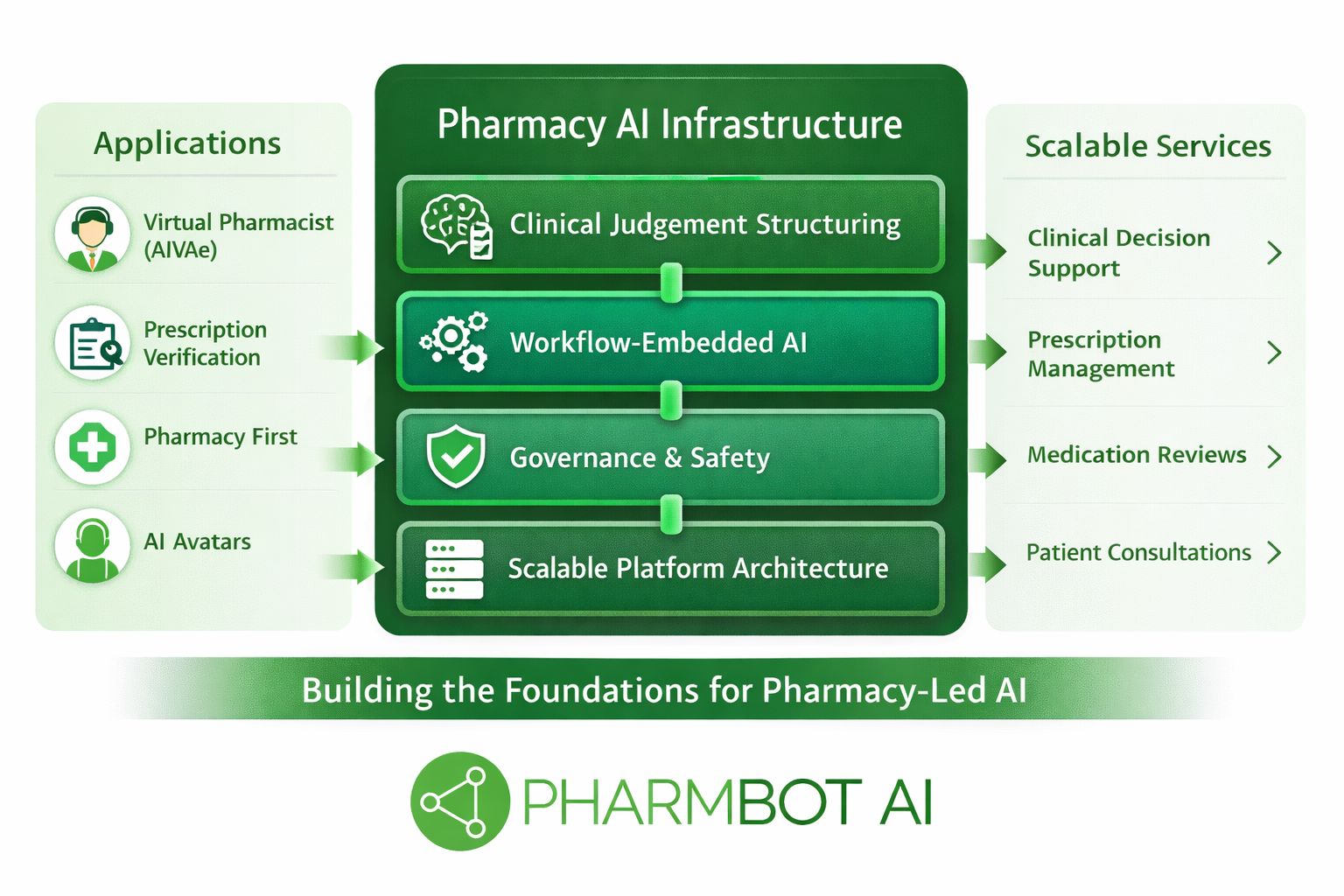
    This infrastructure operates across four interdependent layers:

    1. Structuring Clinical Judgement

    PharmBot captures and structures pharmacist decision-making earlier in the care pathway – where variation, risk, and system cost are highest.

    2. Workflow-Embedded AI

    AI is embedded directly into pharmacy workflows, supporting real decisions in real time, rather than existing as a parallel interface.

    3. Governance by Design

    Clinical safety, explainability, auditability, and regulatory readiness are designed into the system architecture from the outset – not added retrospectively.

    4. Scalable Service Enablement

    The platform enables pharmacy-led services to be delivered consistently and safely, without increasing cognitive load or operational fragility.

    This is the distinction between using AI in pharmacy and building pharmacy-ready AI systems.

    Applications as Proof, Not Distraction

    PharmBot AI will continue to develop and deploy applications, including virtual pharmacist support (AIVAe), prescription verification, Pharmacy First service workflows, and emerging interfaces such as avatars.

    These applications are not deviations from the infrastructure strategy.

    They are how the infrastructure is validated in practice, exposing real clinical edge cases, regulatory constraints, and workflow pressures that cannot be discovered in abstraction.

    Each application strengthens the underlying decision, governance, and workflow layers, making the platform more robust over time.

    In this model, applications are expressions of infrastructure, not endpoints.

    Why Infrastructure Matters Now

    Healthcare systems are increasingly constrained by workforce shortages, cost pressure, and rising service demand. Pharmacy is no exception.

    AI will not resolve these pressures through isolated productivity tools.

    It will do so only if clinical judgement can be:

    • captured reliably
    • applied consistently
    • governed transparently
    • and scaled without eroding professional accountability

    That requires infrastructure — not experimentation.

    Recognition and Direction

    As PharmBot AI moves into this next phase, the focus remains on deepening the clinical and governance foundations required for long-term system adoption.

    This direction has begun to receive national recognition, but the work itself predates that visibility.

    The priority now is not acceleration for its own sake, but precision: building systems that healthcare organisations can trust over time.

    Looking Ahead

    The next phase of PharmBot AI will concentrate on:

    • Expanding decision infrastructure across pharmacy-led pathways
    • Continuing to deliver and refine real-world applications
    • Preparing the platform for broader health system and international contexts
    • Working selectively with partners who prioritise safety, outcomes, and sustainability

    Progress will remain deliberate.

    Infrastructure, by definition, is built to last.

    Closing Thought

    AI will not transform pharmacy through novelty.

    It will do so through quiet, dependable, well-governed infrastructure that allows pharmacists to deliver high-value care at scale.

    That is the problem PharmBot AI exists to solve.

  • AI, Personalised Medicine and the NHS: Why Innovation Must Reach the Frontline

    AI, Personalised Medicine and the NHS: Why Innovation Must Reach the Frontline

    The UK has long been recognised as a global leader in medical research and life sciences innovation. From pioneering genomics programmes to world-class universities and research institutions, the UK consistently produces breakthroughs in healthcare science.

    However, translating innovation into routine clinical practice within the NHS has often proved far more difficult.

    Recognising this challenge, the House of Lords Science and Technology Committee has recently launched an inquiry into innovation in the NHS, with a particular focus on personalised medicine and artificial intelligence.

    The inquiry aims to explore why many promising healthcare innovations struggle to reach widespread adoption within the NHS, despite the UK’s strong research ecosystem.

    This question sits at the heart of modern healthcare policy.

    The Promise of Artificial Intelligence in Healthcare

    Artificial intelligence is rapidly emerging as one of the most transformative technologies in healthcare. Across the world, AI is being explored in areas such as:

    • medical imaging and diagnostics
    • predictive analytics and risk modelling
    • clinical decision support
    • healthcare workflow automation.

    At the same time, personalised medicine is reshaping the way treatments are developed and delivered. Rather than applying a one-size-fits-all approach to healthcare, personalised medicine seeks to tailor treatment decisions to the individual characteristics of each patient.

    Artificial intelligence has the potential to play an important role in enabling this shift by helping clinicians interpret complex data and apply clinical guidelines more effectively.

    Importantly, AI should not be viewed as replacing healthcare professionals. Instead, its greatest value lies in supporting clinicians by improving access to information, structuring clinical workflows, and assisting with decision-making.

    The Challenge of NHS Innovation

    Despite the promise of these technologies, the NHS has historically faced challenges in adopting innovation at scale.

    Several structural barriers contribute to this problem.

    Fragmented procurement

    The NHS is a complex system involving multiple organisations responsible for commissioning services and adopting technologies. This fragmentation can make it difficult for new innovations to scale nationally.

    Regulatory complexity

    Digital health technologies must navigate multiple regulatory frameworks, including medical device regulation, data protection requirements, and NHS digital standards. While these frameworks are essential for patient safety, they can create uncertainty for innovators.

    Integration with existing systems

    Healthcare technologies must integrate with existing clinical systems such as electronic patient records and prescribing platforms. Achieving interoperability remains a major challenge.

    Funding and incentives

    Many digital innovations improve clinical efficiency or workflow rather than generating new reimbursable services. As a result, existing commissioning models may not always support the adoption of such technologies.

    The new parliamentary inquiry will examine these issues and consider what changes may be needed to enable innovation to reach patients more effectively.

    The Role of Artificial Intelligence in Clinical Workflows

    While much discussion around AI in healthcare focuses on diagnostics or research, another important application lies in supporting everyday clinical workflows.

    Healthcare professionals increasingly operate under significant time pressure, while clinical guidelines and regulatory requirements continue to grow in complexity.

    AI-enabled systems could assist clinicians by:

    • guiding structured patient assessments
    • analysing patient responses
    • identifying relevant clinical guidance
    • generating consultation documentation
    • supporting safe decision-making.

    By assisting clinicians with these processes, AI tools have the potential to reduce administrative burden while improving the consistency and quality of care.

    The Opportunity in Community-Based Care

    Much of the discussion around healthcare innovation focuses on hospitals or specialist services. However, many opportunities for digital innovation lie within frontline community healthcare settings.

    Across the NHS, community-based services such as general practice and pharmacy are increasingly responsible for delivering accessible clinical care.

    For example, the expansion of services such as Pharmacy First reflects a growing recognition of the clinical role pharmacists can play in managing common conditions and supporting primary care.

    As these services expand, the need for digital tools that support structured consultations, clinical documentation and decision-making will also increase.

    Artificial intelligence may therefore have an important role to play in supporting clinicians across the wider primary care workforce.

    From Innovation to Implementation

    The UK has the scientific expertise, healthcare system and digital capabilities required to become a global leader in AI-enabled healthcare.

    However, achieving this goal will depend not only on developing new technologies, but also on ensuring that innovation can be adopted safely and effectively within real clinical environments.

    The inquiry launched by the House of Lords Science and Technology Committee represents an important opportunity to examine how the NHS can better support the translation of innovation into patient care.

    Ultimately, the challenge facing the NHS is not simply one of innovation.

    It is a question of how quickly and effectively new technologies can be integrated into the healthcare system to benefit both clinicians and patients.

    Artificial intelligence and personalised medicine may represent some of the most significant healthcare innovations of our time. Ensuring that these advances reach the frontline of healthcare delivery will be essential in shaping the future of the NHS.

  • Beyond the Hype: Why AI Like ChatGPT Shouldn’t Give Medical Advice

    Beyond the Hype: Why AI Like ChatGPT Shouldn’t Give Medical Advice

    By Asif Mukhtar, Founder & CEO (Consultant Pharmacist), PharmBot AI

    Artificial intelligence has reshaped the way we access information — including health information. Patients are increasingly turning to large language models (LLMs) like ChatGPT for answers about symptoms, treatments, and even drug interactions.

    But as impressive as these systems are, there’s a crucial boundary that too many people — including healthcare innovators — overlook: AI models are not licensed clinicians, and they must not give medical advice.

    This isn’t just a legal technicality. It’s a matter of safety, accountability, and trust.

    The Line Between Information and Advice

    According to OpenAI’s latest usage policies (November 2025), ChatGPT and similar models are prohibited from providing “tailored advice that requires a licence, such as legal or medical advice.”

    Instead, these systems can only offer general educational information — for example, explaining how hypertension is treated, what PGDs are, or how pharmacists fit into digital healthcare systems.

    That distinction sounds small but it’s critical. Once an AI system begins suggesting what a specific patient should do — what drug to take, what dose, or whether to seek urgent care — it crosses into regulated territory that requires professional accountability.

    And that’s where things can go dangerously wrong.

    Why AI “Advice” Is Still Unsafe

    Even the most advanced LLMs remain probabilistic — they generate plausible text based on patterns in data, not verified medical reasoning.

    They can sound confident while being clinically wrong, misinterpreting symptoms, or overlooking contraindications.

    Studies continue to show that, without human oversight, LLMs can produce unsafe or misleading medical outputs. The technology simply hasn’t reached a level of reliability where autonomous decision-making is acceptable in healthcare.

    This is why regulators, including the UK’s MHRA, the FDA, and the Saudi Food and Drug Authority (SFDA), are moving toward frameworks that require validation, traceability, and clinician oversight for all AI-driven medical software.

    What Responsible Use Looks Like

    In healthcare, AI should augment, not replace, professional judgement.

    That’s the principle we’ve built into AIVAe, PharmBot AI’s flagship assistant. It supports pharmacists and clinical teams by automating documentation, checking compliance, and surfacing information — not by giving unverified medical advice.

    The pharmacist remains in control, the clinical decision remains human, and the AI remains a support system — an intelligent colleague, not an autonomous prescriber.

    This design philosophy is what separates safe, compliant innovation from dangerous experimentation.

    The Role of Pharmacists in the AI Era

    Pharmacists are uniquely positioned to lead the responsible adoption of AI in healthcare.
    Our profession is built on precision, evidence, and accountability — the same qualities that AI must now be trained to respect.

    As we integrate digital tools into practice, we must demand transparency, auditability, and validation.
    AI can streamline our workflows, predict risks, and free us to focus on patient care — but only if it’s implemented within the ethical and professional boundaries that protect patients.

    Final Thought

    AI’s potential in healthcare is extraordinary — but so are its risks.

    The real innovation lies not in pushing AI to “act like a doctor,” but in building systems that make doctors, pharmacists, and nurses smarter, faster, and safer in what they already do.

    At PharmBot AI, that’s the standard we’re holding ourselves to.  Because in healthcare, the line between innovation and irresponsibility is drawn where patient safety begins.

  • Shaping the Future of Pharmacy AI: Why We’re Building the PharmBot Global Advisory Council

    Shaping the Future of Pharmacy AI: Why We’re Building the PharmBot Global Advisory Council

    The Global Moment for Pharmacy AI

    Pharmacy is standing at a tipping point. Artificial intelligence is no longer a distant concept; it is here, reshaping the way medicines are managed, prescriptions are verified, and patients receive care. At PharmBot, we believe AI can empower pharmacists to deliver safer, faster, and more efficient services, freeing up their expertise to focus where it matters most: patient health.

    But healthcare innovation cannot happen in isolation. AI in pharmacy will only succeed if it earns the trust of healthcare professionals, regulators, and patients alike. That trust can only be built when innovation is guided by a broad range of expertise, not just technologists, but clinicians, regulators, and strategists working together.

    That is why PharmBot is establishing the Global Advisory Council – a body designed to guide not only our own journey, but to help set new standards for the responsible, globally scalable use of AI in pharmacy.

    Why a Global Advisory Council?

    AI in healthcare must be built on strong foundations. For PharmBot, these are clear:

    • Clinical safety – every algorithm must strengthen, never compromise, patient care.
    • Regulatory integrity – alignment with national and international health authorities is non-negotiable.
    • Strategic foresight – expansion into new health systems must be guided by wisdom and experience, not speed alone.

    The Global Advisory Council will bring together respected leaders from pharmacy, healthcare systems, regulation, academia, and digital health investment to ensure these principles are embedded in everything we do.

    This will not be a symbolic body. Its role will be to challenge us, advise us, and guide us as we expand into new regions and new applications of AI.

    Global Interest, Global Responsibility

    PharmBot’s mission has already captured attention well beyond the UK. In recent months, we have been approached by healthcare leaders across multiple continents — from the Middle East to North America, Asia-Pacific, and emerging markets in Eastern Europe and Africa.

    These conversations have confirmed two important truths:

    1. The challenges facing pharmacists are universal. Medication safety, workload pressures, and service expansion are struggles shared across countries and health systems.
    2. The solutions we build must be guided by global perspectives, not local silos. A model that works in London must also adapt to Riyadh, Singapore, or Johannesburg.

    This breadth of international attention makes it clear: a Global Advisory Council is not just desirable, it is essential. It will ensure that as PharmBot grows, we remain globally relevant, locally adaptable, and consistently aligned with the highest standards of safety and integrity.

    What the Council Will Achieve

    The Council will act as a compass for PharmBot’s next chapter, focused on three core aims:

    1. Empowering Safe AI
      • Reviewing our clinical frameworks.
      • Validating our AI assistant, AIVAe, against international safety standards.
      • Embedding transparency and accountability into every product decision.
    2. Bridging Borders
      • Advising on alignment with regulatory requirements in the UK, EU, Gulf region, and beyond.
      • Helping PharmBot adapt to the unique needs of different health systems.
      • Ensuring patient safety and pharmacist empowerment remain universal priorities.
    3. Guiding Growth
      • Shaping our global partnerships and collaborations.
      • Advising on market access, commercial models, and investment strategies.
      • Supporting PharmBot’s ambition to become the world’s leading AI platform for pharmacy services.

    A Council with Global Voices

    The PharmBot Global Advisory Council will be structured to ensure both depth and breadth of expertise. It will include two specialised committees:

    • Scientific & Clinical Advisory Committee – composed of senior pharmacists, clinical leaders, ex-regulators, academics, and health system representatives.
    • Strategic & Commercial Advisory Committee – featuring former senior executives from major pharmacy groups, digital health investors, policy experts, and international healthcare leaders.

    Together, these committees will ensure PharmBot is guided not just by vision, but by lived experience, evidence, and strategy.

    Looking Ahead

    The PharmBot Global Advisory Council is more than a governance structure. It is a declaration of intent.

    We believe the future of pharmacy AI must be:

    • Safe – grounded in science and validated by experts.
    • Ethical – developed with integrity and transparency.
    • Global – shaped by diverse voices across healthcare systems and geographies.

    As PharmBot expands, the Council will ensure our innovations remain true to these principles, helping us to deliver AI that is not only powerful, but also trusted by the people it serves.

    By convening international voices, we aim to set a new benchmark for how AI should be developed, validated, and governed in healthcare.

    The Future We Envision

    The future of pharmacy is global.  The future of pharmacy is AI.  And with the PharmBot Global Advisory Council, that future will be safe, trusted, and transformative.