Tag: Pharmacy AI

  • Beyond the Hype: Why AI Like ChatGPT Shouldn’t Give Medical Advice

    Beyond the Hype: Why AI Like ChatGPT Shouldn’t Give Medical Advice

    By Asif Mukhtar, Founder & CEO (Consultant Pharmacist), PharmBot AI

    Artificial intelligence has reshaped the way we access information — including health information. Patients are increasingly turning to large language models (LLMs) like ChatGPT for answers about symptoms, treatments, and even drug interactions.

    But as impressive as these systems are, there’s a crucial boundary that too many people — including healthcare innovators — overlook: AI models are not licensed clinicians, and they must not give medical advice.

    This isn’t just a legal technicality. It’s a matter of safety, accountability, and trust.

    The Line Between Information and Advice

    According to OpenAI’s latest usage policies (November 2025), ChatGPT and similar models are prohibited from providing “tailored advice that requires a licence, such as legal or medical advice.”

    Instead, these systems can only offer general educational information — for example, explaining how hypertension is treated, what PGDs are, or how pharmacists fit into digital healthcare systems.

    That distinction sounds small but it’s critical. Once an AI system begins suggesting what a specific patient should do — what drug to take, what dose, or whether to seek urgent care — it crosses into regulated territory that requires professional accountability.

    And that’s where things can go dangerously wrong.

    Why AI “Advice” Is Still Unsafe

    Even the most advanced LLMs remain probabilistic — they generate plausible text based on patterns in data, not verified medical reasoning.

    They can sound confident while being clinically wrong, misinterpreting symptoms, or overlooking contraindications.

    Studies continue to show that, without human oversight, LLMs can produce unsafe or misleading medical outputs. The technology simply hasn’t reached a level of reliability where autonomous decision-making is acceptable in healthcare.

    This is why regulators, including the UK’s MHRA, the FDA, and the Saudi Food and Drug Authority (SFDA), are moving toward frameworks that require validation, traceability, and clinician oversight for all AI-driven medical software.

    What Responsible Use Looks Like

    In healthcare, AI should augment, not replace, professional judgement.

    That’s the principle we’ve built into AIVAe, PharmBot AI’s flagship assistant. It supports pharmacists and clinical teams by automating documentation, checking compliance, and surfacing information — not by giving unverified medical advice.

    The pharmacist remains in control, the clinical decision remains human, and the AI remains a support system — an intelligent colleague, not an autonomous prescriber.

    This design philosophy is what separates safe, compliant innovation from dangerous experimentation.

    The Role of Pharmacists in the AI Era

    Pharmacists are uniquely positioned to lead the responsible adoption of AI in healthcare.
    Our profession is built on precision, evidence, and accountability — the same qualities that AI must now be trained to respect.

    As we integrate digital tools into practice, we must demand transparency, auditability, and validation.
    AI can streamline our workflows, predict risks, and free us to focus on patient care — but only if it’s implemented within the ethical and professional boundaries that protect patients.

    Final Thought

    AI’s potential in healthcare is extraordinary — but so are its risks.

    The real innovation lies not in pushing AI to “act like a doctor,” but in building systems that make doctors, pharmacists, and nurses smarter, faster, and safer in what they already do.

    At PharmBot AI, that’s the standard we’re holding ourselves to.  Because in healthcare, the line between innovation and irresponsibility is drawn where patient safety begins.
  • AIVAe Shortlisted for the HSJ Partnership Awards 2026 – Building the Future of AI-Enabled Pharmacy

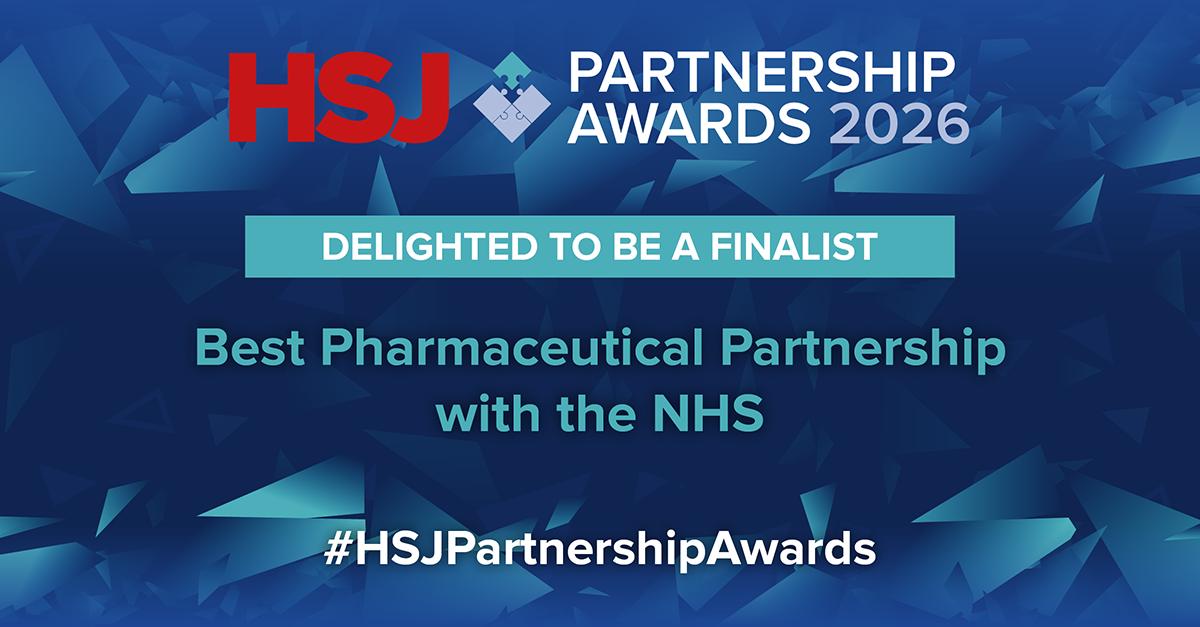
    AIVAe Shortlisted for the HSJ Partnership Awards 2026 – Building the Future of AI-Enabled Pharmacy

    I’m incredibly proud to share that our work at PharmBot AI has been shortlisted for the Best Pharmaceutical Partnership with the NHS at the 2026 HSJ Partnership Awards for our project:

    AIVAe – Building the Future of AI-Enabled Pharmacy Partnerships.

    This is a significant moment for our mission, not because of the award itself, but because of what it represents: recognition from across the NHS that responsible AI and clinical pharmacy expertise can work together to support safer, smarter medicines optimisation.

    And importantly – this nomination isn’t mine alone. It reflects the contributions of UK pharmacy networks, NHS partners, clinical leaders and frontline pharmacists who have worked with us to build AIVAe from concept to real-world deployment.

    Why This Matters Now

    Across the NHS, pharmacy teams are facing new levels of clinical demand, unprecedented workload pressure, and a growing need for consistent, evidence-based decision support. The expansion of clinical services, evolving medicines guidance, and increased complexity of care all point to the same conclusion:

    We need new models of support to protect patient safety and enable pharmacists to work at the top of their licence.

    AIVAe was built to meet that need.

    Not as a replacement for pharmacists – but as a clinical assistant, designed to streamline the routine, evidence-heavy parts of medicines optimisation so people can focus on patients, not paperwork.

    A Partnership Approach – Not Just a Platform

    From day one, the aim wasn’t to “launch a product into the NHS”.

    It was to build a partnership model.

    AIVAe was co-designed:

    • with pharmacy networks, who shaped the clinical use cases
    • with NHS stakeholders, who supported governance, safety and assurance
    • with practising pharmacists, whose feedback shaped every iteration

    That partnership approach has been critical. It has shaped:

    • how AIVAe supports decision-making
    • how governance is embedded
    • how recommendations are surfaced
    • how automation integrates into real workflows
    • how safety controls are applied
    • how the system scales responsibly within NHS environments

    The result is a responsible, governed AI tool that supports — rather than disrupts — the clinical role of pharmacists.

    Evidence of Real-World Impact

    We know that innovation only matters if it delivers measurable value.

    Early deployments across our UK pharmacy network have shown:

    • reduced routine clinical workload
    • faster access to relevant guidance
    • more standardised medicine optimisation checks
    • increased confidence for frontline pharmacists
    • strengthened patient safety processes

    This isn’t theory. It’s evidence from real pharmacies, working with real pressure — and achieving meaningful improvements in workflow and governance.

    A Moment for Pharmacy

    Being shortlisted for the HSJ Partnership Awards tells us something important:

    The NHS sees AI-enabled pharmacy as part of its future.

    Not as a distant vision, but as a practical way to reduce pressure, support clinical decision-making, and strengthen medicines safety right now, inside the existing system.

    For the pharmacy profession, this is a key moment.

    It shows that the sector is ready to adopt innovation that protects clinical judgement, reinforces governance, and reduces workload safely.

    My Personal Reflection

    When I first founded PharmBot AI, the goal was simple: to build tools that support pharmacists in the places where time, information and safety pressures converge.

    Over time, that simple goal has grown into a wider mission — to develop the first true AI-enabled pharmacy model, built around partnership, evidence and responsibility.

    To see that mission recognised by HSJ is something I’m deeply proud of — not for me, but for everyone who believes in the future of this profession.

    Innovation in pharmacy will not be defined by technology alone — it will be defined by the way we work together to make that technology safe, useful and trusted.

    What Happens Next

    The final presentation to the judging panel takes place in January, and the winners will be announced on 19 March 2026 at Evolution London.

    Between now and then, our focus remains exactly the same:

    • supporting our pharmacy network
    • strengthening governance
    • collecting outcome evidence
    • working with NHS partners
    • listening to pharmacists
    • improving through real-world use

    AIVAe is still early in its journey. But this nomination shows that we’re building on the right foundations.

    Thank You

    To everyone in our pharmacy network, NHS collaborators, advisors and clinical colleagues — thank you for your support, challenge and partnership.

    AIVAe is the product of your experience, your feedback and your ambition for what pharmacy can become.

    And to the HSJ judges — thank you for recognising the value of a responsible, partnership-led approach to AI in healthcare.

    If you’d like to understand more about AIVAe, our approach to governance, or opportunities to collaborate, please feel free to connect or reach out directly.

    — Asif

  • AIVAe 2.0 — The Vision for the Agentic Future of Pharmacy

    AIVAe 2.0 — The Vision for the Agentic Future of Pharmacy

    When I built AIVAe 1.0, the goal was clear: to create an intelligent assistant that supports pharmacists and their teams in delivering safer, smarter, and more efficient care.

    AIVAe 1.0 achieved that — it proved that AI can seamlessly fit into pharmacy workflows, simplify processes, and empower staff without disrupting their professional judgment.

    But innovation never stands still.

    Today, I’m excited to share the next stage in AIVAe’s journey — the vision for AIVAe 2.0, an evolution that will usher in what we call the Agentic Intelligence Era.

    From Assistance to Intelligent Action

    AIVAe 2.0 represents a shift from reactive assistance to proactive, goal-driven intelligence.

    We’re exploring how AIVAe can evolve from simply responding to queries to understanding goals, planning actions, and executing tasks within safe, regulated boundaries.

    In practical terms, that means moving toward a system capable of:

    • Monitoring pharmacy workflows and identifying issues before they occur
    • Preparing documentation and patient interactions automatically
    • Coordinating tasks across systems — freeing pharmacists to focus on clinical care
    • Learning from feedback to continuously improve its support

    This isn’t AI for automation’s sake — it’s AI for empowerment.

    Why This Matters

    Pharmacy is entering a new era of digital transformation.

    With increasing service complexity, clinical demand, and regulatory pressures, we need systems that don’t just provide data — they provide decision support, workflow intelligence, and adaptive action.

    That’s what agentic AI offers — a future where intelligent systems can anticipate what’s needed, not just react when asked.

    It’s a shift from tools that respond, to partners that collaborate.

    The Journey Ahead

    Development of AIVAe 2.0 is now underway in its conceptual stage.

    We’re currently defining how agentic intelligence can be safely introduced into real pharmacy environments — ensuring full compliance, transparency, and human oversight at every step.

    This next phase will focus on research, design, and collaboration with pharmacists, technologists, and regulators to shape the framework for responsible agentic AI in healthcare.

    A Vision for the Future

    PharmBot AI was built on the principle that technology should enhance human expertise, not replace it.

    AIVAe 2.0 continues that mission — evolving from a supportive assistant into an intelligent, adaptive system that helps pharmacists deliver care at a new level of precision and efficiency.

    The Agentic Future of Pharmacy starts here — with a vision, a plan, and a commitment to lead responsibly.

    Stay tuned as we share updates on AIVAe 2.0’s design and development journey in the months ahead.

    AIVAe 2.0 – From Support to Autonomy.

    The next evolution of intelligent pharmacy begins now.

    💻 www.pharmbotai.com

    ✉️ info@pharmbotai.com

  • The Digital Shift That Could Redefine Pharmacy: What the UK Can Learn from the U.S.

    The Digital Shift That Could Redefine Pharmacy: What the UK Can Learn from the U.S.

    A Global Change in Motion

    Imagine every prescription arriving in a format that is instantly clear, structured, and safe. No ambiguity. No chasing prescribers for clarification. No unnecessary delays for patients waiting at the counter.

    This isn’t a distant dream  it’s about to become a reality in the United States.

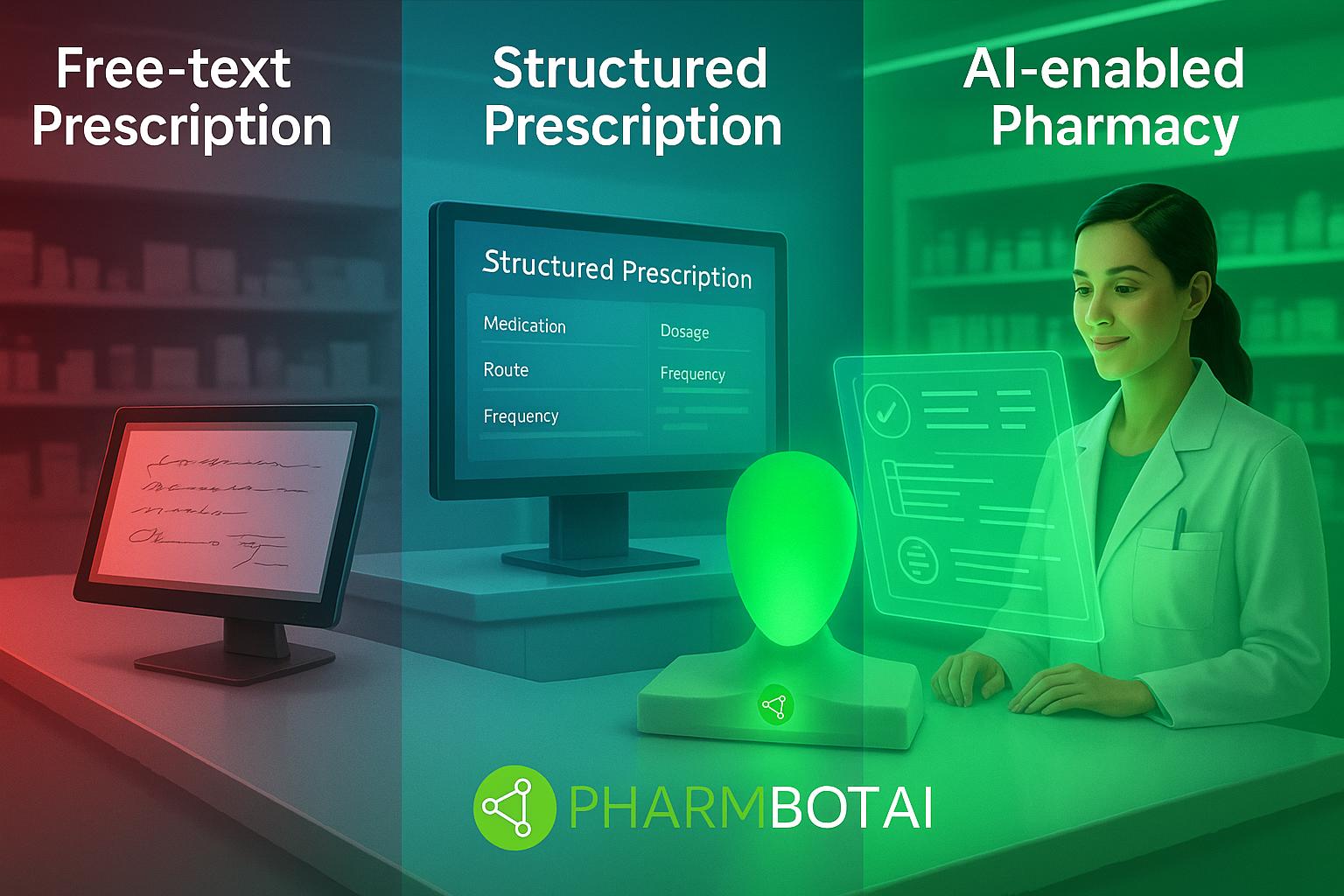
    From 2027 onwards, every U.S. pharmacy will be required to comply with new NCPDP standards, transforming how prescriptions are written and shared. On the surface, it may look like a technical update. In truth, it is a foundation shift.

    • Prescriptions will move from free-text notes to structured, machine-readable instructions
    • AI will finally have the clean, standardised data it needs to act on
    • Providers and pharmacies will be able to communicate without silos

    The goal is simple but powerful: clearer prescriptions, fewer errors, faster coordination, and AI-enabled pharmacy at scale.

    Why This Matters for Patients and Pharmacists

    Every pharmacist knows the frustration of unclear prescriptions. A missing dose instruction, a confusing abbreviation, or handwriting that leaves too much to interpretation these aren’t just inconveniences. They’re patient safety risks.

    By standardising prescriptions into structured digital formats, the U.S. is not only embracing efficiency, but also making a profound patient safety intervention. Every avoided error is a patient protected. Every minute saved is time pharmacists can reinvest in care, counselling, and clinical services.

    For the workforce, this shift means less firefighting, more care. Instead of chasing prescribers or double-checking ambiguous instructions, pharmacists will be supported by AI-driven systems that flag risks instantly. It’s about reducing the burden, protecting the workforce, and enabling pharmacy to expand its clinical role with confidence.

    The UK: Waiting or Leading?

    Here in the UK, we don’t yet have the same mandate. Structured prescription standards are not a regulatory requirement, and system interoperability remains a significant challenge.

    But that doesn’t mean we should wait until 2027 to see these benefits. In fact, waiting comes with a cost: more errors, more inefficiency, and more pressure on an already stretched workforce.

    If the U.S. can set a deadline, what’s stopping the UK from moving faster?

    Building the Foundations Now

    At PharmBot AI, we’ve been asking this very question. That’s why we’ve started laying the same digital foundations that will soon be mandated in the U.S.

    • Prescription Verification Service: Using AI to review prescriptions in real time, flagging potential risks and reducing errors before they reach patients.
    • AIVAe Platform: Providing pharmacists with structured, audit-ready support for clinical services and patient engagement.

    These tools aren’t just about compliance. They’re about future-proofing pharmacy creating an environment where pharmacists can thrive, patients can feel safer, and the NHS can deliver smarter, more coordinated care.

    Collaboration Is Key

    Technology alone will not deliver this transformation. It requires collaboration at every level:

    • Regulators creating the frameworks for safe and effective AI adoption
    • IT system providers enabling true interoperability across the NHS
    • Pharmacists co-designing and testing solutions so they reflect real practice
    • Innovators bringing forward safe, scalable AI tools with patient benefit at their core

    When these groups work together, the impact multiplies. The pharmacy of the future is not built in isolation it is co-created.

    A Vision for the Pharmacy of the Future

    So, what does this look like in practice?

    I see a pharmacy where prescriptions flow seamlessly into structured systems. AI supports pharmacists by automatically checking for interactions, verifying appropriateness, and flagging anomalies in real time. Robotics assist with dispensing. Pharmacists spend their time on what matters most, providing clinical care, supporting long-term condition management, and engaging patients in their own health.

    This is not a vision of replacement. It’s a vision of empowerment. Technology takes on the repetitive, error-prone tasks, while pharmacists step fully into their role as accessible, trusted clinical leaders in the community and across the NHS.

    The Time to Act

    The U.S. has drawn a line in the sand with its 2027 mandate. The UK has an opportunity: either wait for regulation, or act now and lead the way.

    Pharmacies that see this as a strategic upgrade, not a compliance exercise, will be the ones ready to thrive in the next era of AI-driven care.

    For patients, that means safer, faster, more consistent experiences. For pharmacists, it means more time, more impact, and more professional satisfaction. And for the NHS, it means efficiency, resilience, and a future-proofed workforce.

    The digital shift in pharmacy is already underway. The only question left is: will the UK choose to wait, or to lead?

    References

    • NCPDP (2023). SCRIPT Standard Implementation Recommendations. National Council for Prescription Drug Programs. Available at: https://www.ncpdp.org (Accessed: 18 August 2025).
    • NHS England (2021). Digital Technology Assessment Criteria (DTAC). NHS England. Available at: https://www.england.nhs.uk/digitaltechnology/ (Accessed: 18 August 2025).

  • Shaping the Future of Pharmacy AI: Why We’re Building the PharmBot Global Advisory Council

    Shaping the Future of Pharmacy AI: Why We’re Building the PharmBot Global Advisory Council

    The Global Moment for Pharmacy AI

    Pharmacy is standing at a tipping point. Artificial intelligence is no longer a distant concept; it is here, reshaping the way medicines are managed, prescriptions are verified, and patients receive care. At PharmBot, we believe AI can empower pharmacists to deliver safer, faster, and more efficient services, freeing up their expertise to focus where it matters most: patient health.

    But healthcare innovation cannot happen in isolation. AI in pharmacy will only succeed if it earns the trust of healthcare professionals, regulators, and patients alike. That trust can only be built when innovation is guided by a broad range of expertise, not just technologists, but clinicians, regulators, and strategists working together.

    That is why PharmBot is establishing the Global Advisory Council – a body designed to guide not only our own journey, but to help set new standards for the responsible, globally scalable use of AI in pharmacy.

    Why a Global Advisory Council?

    AI in healthcare must be built on strong foundations. For PharmBot, these are clear:

    • Clinical safety – every algorithm must strengthen, never compromise, patient care.
    • Regulatory integrity – alignment with national and international health authorities is non-negotiable.
    • Strategic foresight – expansion into new health systems must be guided by wisdom and experience, not speed alone.

    The Global Advisory Council will bring together respected leaders from pharmacy, healthcare systems, regulation, academia, and digital health investment to ensure these principles are embedded in everything we do.

    This will not be a symbolic body. Its role will be to challenge us, advise us, and guide us as we expand into new regions and new applications of AI.

    Global Interest, Global Responsibility

    PharmBot’s mission has already captured attention well beyond the UK. In recent months, we have been approached by healthcare leaders across multiple continents — from the Middle East to North America, Asia-Pacific, and emerging markets in Eastern Europe and Africa.

    These conversations have confirmed two important truths:

    1. The challenges facing pharmacists are universal. Medication safety, workload pressures, and service expansion are struggles shared across countries and health systems.
    2. The solutions we build must be guided by global perspectives, not local silos. A model that works in London must also adapt to Riyadh, Singapore, or Johannesburg.

    This breadth of international attention makes it clear: a Global Advisory Council is not just desirable, it is essential. It will ensure that as PharmBot grows, we remain globally relevant, locally adaptable, and consistently aligned with the highest standards of safety and integrity.

    What the Council Will Achieve

    The Council will act as a compass for PharmBot’s next chapter, focused on three core aims:

    1. Empowering Safe AI
      • Reviewing our clinical frameworks.
      • Validating our AI assistant, AIVAe, against international safety standards.
      • Embedding transparency and accountability into every product decision.
    2. Bridging Borders
      • Advising on alignment with regulatory requirements in the UK, EU, Gulf region, and beyond.
      • Helping PharmBot adapt to the unique needs of different health systems.
      • Ensuring patient safety and pharmacist empowerment remain universal priorities.
    3. Guiding Growth
      • Shaping our global partnerships and collaborations.
      • Advising on market access, commercial models, and investment strategies.
      • Supporting PharmBot’s ambition to become the world’s leading AI platform for pharmacy services.

    A Council with Global Voices

    The PharmBot Global Advisory Council will be structured to ensure both depth and breadth of expertise. It will include two specialised committees:

    • Scientific & Clinical Advisory Committee – composed of senior pharmacists, clinical leaders, ex-regulators, academics, and health system representatives.
    • Strategic & Commercial Advisory Committee – featuring former senior executives from major pharmacy groups, digital health investors, policy experts, and international healthcare leaders.

    Together, these committees will ensure PharmBot is guided not just by vision, but by lived experience, evidence, and strategy.

    Looking Ahead

    The PharmBot Global Advisory Council is more than a governance structure. It is a declaration of intent.

    We believe the future of pharmacy AI must be:

    • Safe – grounded in science and validated by experts.
    • Ethical – developed with integrity and transparency.
    • Global – shaped by diverse voices across healthcare systems and geographies.

    As PharmBot expands, the Council will ensure our innovations remain true to these principles, helping us to deliver AI that is not only powerful, but also trusted by the people it serves.

    By convening international voices, we aim to set a new benchmark for how AI should be developed, validated, and governed in healthcare.

    The Future We Envision

    The future of pharmacy is global.  The future of pharmacy is AI.  And with the PharmBot Global Advisory Council, that future will be safe, trusted, and transformative.

  • FIP AI Plan 2025: Shaping the Future of AI in Pharmacy

    FIP AI Plan 2025: Shaping the Future of AI in Pharmacy

    The International Pharmaceutical Federation (FIP) has released its AI Plan 2025, setting out a global roadmap for the responsible use of artificial intelligence in pharmacy. This landmark policy reflects the growing recognition that AI will be a critical enabler of safer, more efficient, and more accessible healthcare worldwide.

    📄 You can read the full plan here: FIP AI Plan 2025 (PDF)

    What the FIP AI Plan 2025 Says

    The plan highlights several key areas where AI can transform pharmacy practice:

    • Clinical decision support: Helping pharmacists make safer, faster, and more informed decisions.
    • Safety and efficiency: Reducing errors, optimising workflows, and supporting patient engagement.
    • Ethics and transparency: Ensuring AI is explainable, accountable, and always under professional oversight.
    • Workforce upskilling: Embedding AI and digital health into pharmacy education and continuous professional development.
    • Global collaboration: Using AI to reduce disparities in healthcare access and outcomes.

    FIP’s message is clear: AI must empower pharmacists, not replace them. It should strengthen professional judgment, improve patient outcomes, and support sustainable health systems.

    How This Relates to PharmBot AI

    At PharmBot AI, this is exactly the mission we have been pursuing. Our intelligent virtual assistant, AIVAe, is designed to:

    • Reduce workload pressures on pharmacy teams.
    • Enhance safety by supporting clinical checks and prescribing decisions.
    • Expand access to care by enabling digital pharmacy services.

    By aligning with FIP’s principles, PharmBot AI is helping to demonstrate how AI can be integrated responsibly into real-world pharmacy practice.

    Our Journey at FIP Congress 2024

    In 2024, PharmBot AI had the privilege of presenting at the FIP Congress, sharing our work on embedding AI into pharmacy service delivery. That moment was not just an opportunity to showcase our innovation, but also to join a global conversation about the role of technology in shaping the future of our profession.

    Looking Ahead

    The FIP AI Plan 2025 provides a powerful framework for innovators, regulators, and healthcare professionals alike. It validates the need for solutions like PharmBot AI and AIVAe, and it challenges us all to continue building AI that is ethical, safe, and impactful.

    As we continue our journey, we are proud to be working in step with the vision set out by FIP — creating tools that empower pharmacists, protect patients, and shape the future of pharmacy worldwide.

  • Advancing Responsible AI in Pharmacy: How PharmBot AI is Applying the Global Playbook

    Advancing Responsible AI in Pharmacy: How PharmBot AI is Applying the Global Playbook

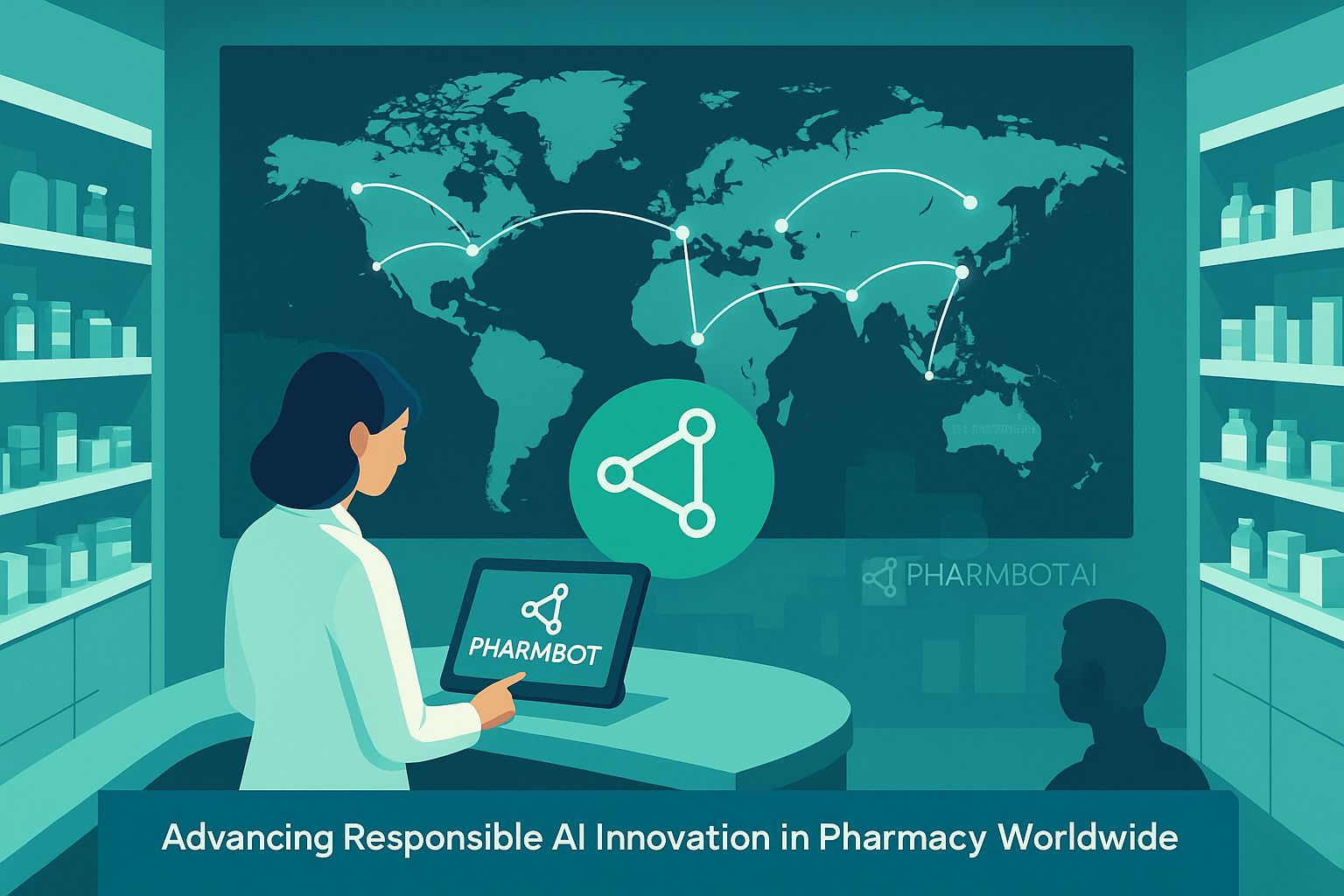
    In September 2025, the World Economic Forum’s AI Governance Alliance, in collaboration with Accenture, released a landmark report: Advancing Responsible AI Innovation: A Playbook.

    This playbook is not regulation. It is something far more practical: a global handbook of nine “plays” that organisations can use to ensure their AI innovations are safe, transparent, and sustainable. From anchoring AI to clear purpose, to embedding governance, transparency, and human-centred design, it provides a practical roadmap for responsible adoption.

    At PharmBot AI, we believe this matters deeply to pharmacy. Unlike other industries, trust in healthcare is non-negotiable. If pharmacists and patients do not have confidence in how AI makes recommendations, adoption will stall — no matter how powerful the technology may be.

    What the Playbook Means for AIVAe

    Our flagship solution, AIVAe, is being built to align with the playbook’s guidance. Here is how the nine plays translate into practice:

    • Purpose-driven: AIVAe’s mission is clear — to support pharmacists in delivering safer, more efficient care, freeing up their time for patients.
    • Governance-first: We are establishing oversight processes, escalation pathways, and aligning development with UK frameworks such as the MHRA AI-Airlock and NHS AI Lab guidance.
    • Lifecycle responsibility: Risk assessments and safety checks are built into design, deployment, and monitoring stages.
    • Human-centred design: Co-created with pharmacists and patients, ensuring usability and accessibility.
    • Transparency and explainability: Every clinical recommendation is backed by authoritative sources (BNF, NICE, MHRA) and fully auditable.
    • Continuous monitoring: Automated alerts for drug updates, safety issues, or bias detection.
    • Skills and culture: Through the planned AIVAe Training Academy, pharmacists and technicians will gain confidence in responsible AI use.
    • Partnerships and standards: We are working with NHS bodies, regulators, and digital health networks to align with open standards.
    • Iteration and adaptation: AIVAe’s roadmap anticipates regulatory change and will evolve to meet the highest standards of responsible AI.

    Why This Matters

    Pharmacy is on the front line of medicines safety. From dispensing controlled drugs such as morphine, to managing high-volume workflows, the risks of error are real and consequential. By embedding responsibility into the DNA of AIVAe, we are ensuring that innovation does not come at the expense of safety — instead, it enhances it.

    The Responsible AI Playbook reinforces what we have always believed: that innovation and responsibility must advance together. AIVAe is our commitment to showing how a UK-born pharmacy AI system can meet global standards of trust, safety, and accountability.

    📌 Next steps: We will be sharing updates on how we are embedding these principles into AIVAe’s upcoming release. Watch this space.

    #ResponsibleAI #Pharmacy #DigitalHealth #Innovation #PharmBotAI #AIVAe