Tag: Pharmacy Technology

  • The Hidden Burden of Pharmacy First –  What No One Is Talking About

    The Hidden Burden of Pharmacy First –  What No One Is Talking About

    Pharmacy First is the right policy – but the wrong conversation

    Pharmacy First is one of the most significant shifts in community pharmacy in a generation. It formally recognises what pharmacists have been doing for years: delivering accessible, front-line clinical care.

    On paper, it’s a win for patients, pharmacists, and the NHS.

    But on the ground, a quieter reality is emerging, one that isn’t being discussed openly enough.

    Pharmacy First isn’t failing because pharmacists lack capability or motivation.
    It’s struggling because the operational and cognitive burden placed on pharmacies has been underestimated.

    And unless that burden is addressed, Pharmacy First risks becoming another well-intentioned service that never fully scales.

    The burden isn’t clinical – it’s infrastructural

    Most commentary focuses on clinical pathways, inclusion criteria, and remuneration. Those matter  but they are not the core problem.

    The real burden sits elsewhere:

    • Cognitive load during consultations
    • Fragmented workflows across multiple systems
    • Documentation pressure under time constraints
    • Clinical accountability without proportional support
    • Audit anxiety in a heavily regulated environment

    Pharmacists are being asked to deliver more clinical services, at higher frequency, with the same physical infrastructure and largely the same digital one.

    That mismatch is where friction appears.

    What a Pharmacy First consultation actually looks like

    In reality, a Pharmacy First consultation is not a simple checklist exercise.

    A pharmacist must simultaneously:

    • Interpret eligibility and red-flag criteria
    • Apply PGDs accurately
    • Maintain clinical judgement
    • Document decisions defensibly
    • Manage time pressure
    • Protect patient safety
    • Remain audit-ready

    All while working in busy, interruption-heavy environments.

    This is complex clinical cognition, compressed into short appointment windows.

    The policy acknowledges this complexity.
    The infrastructure largely does not.

    Why adding “tools” isn’t enough

    Most digital responses to Pharmacy First have focused on tools:

    • Templates
    • Forms
    • Checklists
    • Standalone apps

    These help  but they don’t solve the underlying issue.

    Tools still require the pharmacist to:

    • Remember what applies
    • Interpret guidance in real time
    • Carry the full cognitive and legal load
    • Context-switch repeatedly between systems

    In other words, tools digitise paperwork, they don’t reduce burden.

    What’s missing is something deeper.

    The missing layer: clinical AI infrastructure

    Pharmacy First doesn’t need more apps.
    It needs clinical infrastructure that sits underneath services and supports them safely.

    That infrastructure should:

    • Embed clinical logic into workflows
    • Surface relevant guidance at the point of care
    • Maintain human-in-the-loop control
    • Create defensible audit trails automatically
    • Preserve pharmacist ownership of decisions

    This is not about replacing pharmacists.

    It’s about supporting clinical judgement at scale without increasing risk.

    Why this matters for safety, not just efficiency

    When cognitive load rises, risk rises with it.

    Not because pharmacists are careless  but because humans operating under sustained pressure are more vulnerable to error.

    If Pharmacy First is to expand safely:

    • Across more conditions
    • Across more pharmacies
    • Across more patients

    Then risk must be managed structurally, not informally.

    Clinical AI infrastructure allows:

    • Consistency without rigidity
    • Support without automation creep
    • Oversight without surveillance

    Done correctly, it reduces both clinical risk and professional anxiety.

    What this enables next

    If the right infrastructure is in place, Pharmacy First becomes a foundation not a ceiling.

    It enables:

    • Faster onboarding of new services
    • More consistent national delivery
    • Better outcome measurement
    • Stronger commissioning confidence
    • Future integration with prescribing, diagnostics, and referrals

    Without it, every new service adds friction rather than momentum.

    A quiet truth worth saying out loud

    Pharmacists are not resisting Pharmacy First.

    They are absorbing its weight.

    And many are doing so silently, because professionalism often looks like coping.

    If we want Pharmacy First to succeed long-term, we must stop asking pharmacists to carry system-level complexity alone.

    The solution is not more resilience.  It’s better infrastructure.

    About PharmBot AI

    PharmBot AI is building clinically governed AI infrastructure designed specifically for pharmacy – supporting services like Pharmacy First while preserving safety, accountability, and professional ownership.

    Not as a chatbot.

    Not as a shortcut.

    But as infrastructure fit for regulated clinical care.
  • From Tools to Infrastructure: The Next Phase of PharmBot AI

    From Tools to Infrastructure: The Next Phase of PharmBot AI

    PharmBot AI did not begin with the ambition to build individual AI tools.

    It began with a more fundamental question:

    What infrastructure is required for artificial intelligence to operate safely, consistently, and at scale within pharmacy-led care?

    That question has shaped every design decision since – and it is now defining the next phase of PharmBot AI.

    Why Tools Were Never the End Goal

    Over the past year, PharmBot AI has delivered and tested multiple AI-enabled applications across pharmacy practice, including clinical decision support, workflow augmentation, and service delivery assistance.

    These were never conceived as standalone products.

    They were deliberately built as probes – ways to understand where AI succeeds, where it fails, and, most importantly, why pharmacy settings expose weaknesses that generic healthcare AI often ignores.

    The conclusion was consistent:

    AI in pharmacy does not fail because models lack intelligence.  It fails because the surrounding clinical, regulatory, and operational infrastructure is missing.

    Without structured judgement, workflow integration, and governance by design, even technically advanced systems cannot be trusted in medicines-related care.

    The Shift: PharmBot as AI Infrastructure for Pharmacy

    PharmBot AI is now explicitly focused on infrastructure rather than isolated applications.

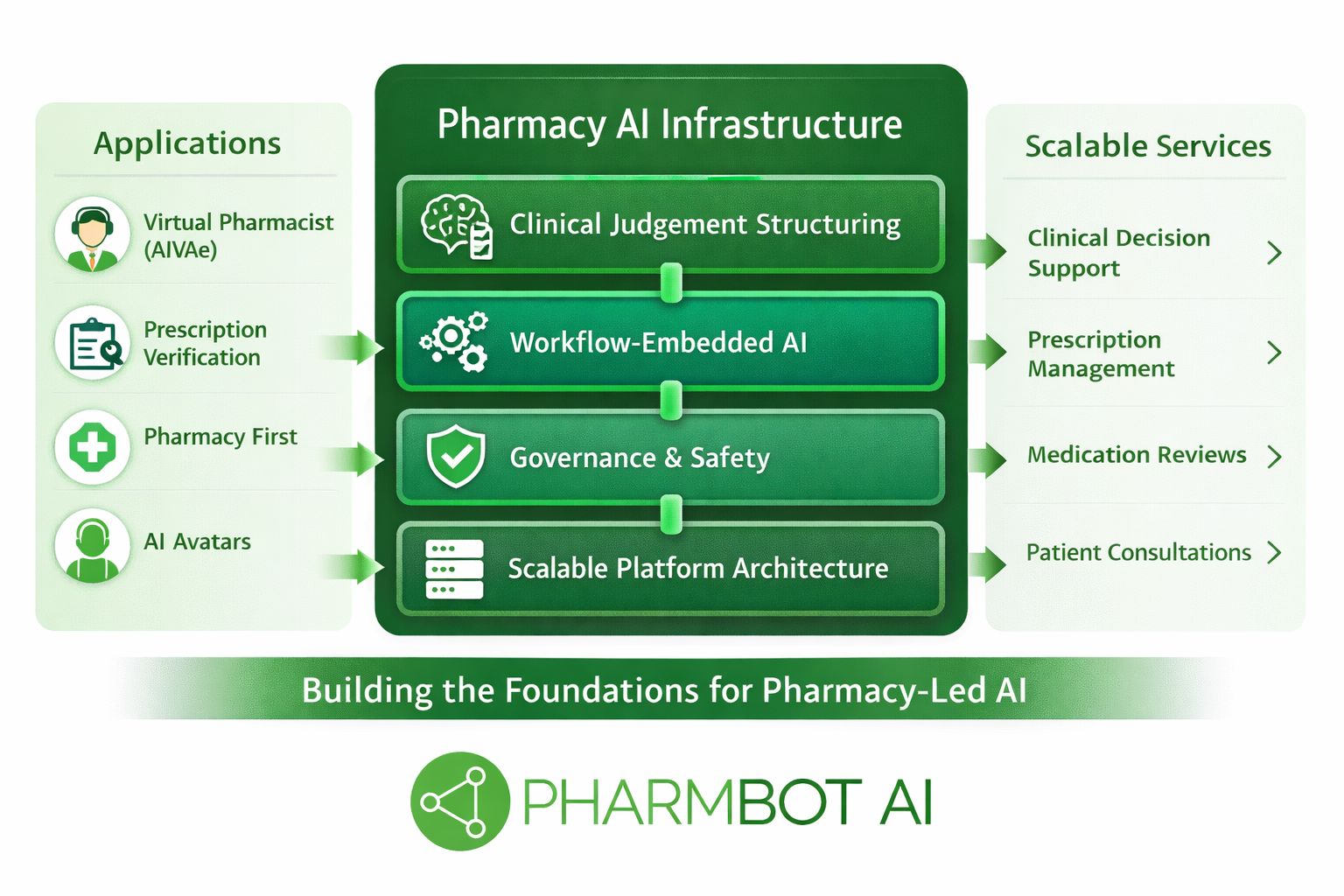
    This infrastructure operates across four interdependent layers:

    1. Structuring Clinical Judgement

    PharmBot captures and structures pharmacist decision-making earlier in the care pathway – where variation, risk, and system cost are highest.

    2. Workflow-Embedded AI

    AI is embedded directly into pharmacy workflows, supporting real decisions in real time, rather than existing as a parallel interface.

    3. Governance by Design

    Clinical safety, explainability, auditability, and regulatory readiness are designed into the system architecture from the outset – not added retrospectively.

    4. Scalable Service Enablement

    The platform enables pharmacy-led services to be delivered consistently and safely, without increasing cognitive load or operational fragility.

    This is the distinction between using AI in pharmacy and building pharmacy-ready AI systems.

    Applications as Proof, Not Distraction

    PharmBot AI will continue to develop and deploy applications, including virtual pharmacist support (AIVAe), prescription verification, Pharmacy First service workflows, and emerging interfaces such as avatars.

    These applications are not deviations from the infrastructure strategy.

    They are how the infrastructure is validated in practice, exposing real clinical edge cases, regulatory constraints, and workflow pressures that cannot be discovered in abstraction.

    Each application strengthens the underlying decision, governance, and workflow layers, making the platform more robust over time.

    In this model, applications are expressions of infrastructure, not endpoints.

    Why Infrastructure Matters Now

    Healthcare systems are increasingly constrained by workforce shortages, cost pressure, and rising service demand. Pharmacy is no exception.

    AI will not resolve these pressures through isolated productivity tools.

    It will do so only if clinical judgement can be:

    • captured reliably
    • applied consistently
    • governed transparently
    • and scaled without eroding professional accountability

    That requires infrastructure — not experimentation.

    Recognition and Direction

    As PharmBot AI moves into this next phase, the focus remains on deepening the clinical and governance foundations required for long-term system adoption.

    This direction has begun to receive national recognition, but the work itself predates that visibility.

    The priority now is not acceleration for its own sake, but precision: building systems that healthcare organisations can trust over time.

    Looking Ahead

    The next phase of PharmBot AI will concentrate on:

    • Expanding decision infrastructure across pharmacy-led pathways
    • Continuing to deliver and refine real-world applications
    • Preparing the platform for broader health system and international contexts
    • Working selectively with partners who prioritise safety, outcomes, and sustainability

    Progress will remain deliberate.

    Infrastructure, by definition, is built to last.

    Closing Thought

    AI will not transform pharmacy through novelty.

    It will do so through quiet, dependable, well-governed infrastructure that allows pharmacists to deliver high-value care at scale.

    That is the problem PharmBot AI exists to solve.

  • AIVAe 2.0 — The Vision for the Agentic Future of Pharmacy

    AIVAe 2.0 — The Vision for the Agentic Future of Pharmacy

    When I built AIVAe 1.0, the goal was clear: to create an intelligent assistant that supports pharmacists and their teams in delivering safer, smarter, and more efficient care.

    AIVAe 1.0 achieved that — it proved that AI can seamlessly fit into pharmacy workflows, simplify processes, and empower staff without disrupting their professional judgment.

    But innovation never stands still.

    Today, I’m excited to share the next stage in AIVAe’s journey — the vision for AIVAe 2.0, an evolution that will usher in what we call the Agentic Intelligence Era.

    From Assistance to Intelligent Action

    AIVAe 2.0 represents a shift from reactive assistance to proactive, goal-driven intelligence.

    We’re exploring how AIVAe can evolve from simply responding to queries to understanding goals, planning actions, and executing tasks within safe, regulated boundaries.

    In practical terms, that means moving toward a system capable of:

    • Monitoring pharmacy workflows and identifying issues before they occur
    • Preparing documentation and patient interactions automatically
    • Coordinating tasks across systems — freeing pharmacists to focus on clinical care
    • Learning from feedback to continuously improve its support

    This isn’t AI for automation’s sake — it’s AI for empowerment.

    Why This Matters

    Pharmacy is entering a new era of digital transformation.

    With increasing service complexity, clinical demand, and regulatory pressures, we need systems that don’t just provide data — they provide decision support, workflow intelligence, and adaptive action.

    That’s what agentic AI offers — a future where intelligent systems can anticipate what’s needed, not just react when asked.

    It’s a shift from tools that respond, to partners that collaborate.

    The Journey Ahead

    Development of AIVAe 2.0 is now underway in its conceptual stage.

    We’re currently defining how agentic intelligence can be safely introduced into real pharmacy environments — ensuring full compliance, transparency, and human oversight at every step.

    This next phase will focus on research, design, and collaboration with pharmacists, technologists, and regulators to shape the framework for responsible agentic AI in healthcare.

    A Vision for the Future

    PharmBot AI was built on the principle that technology should enhance human expertise, not replace it.

    AIVAe 2.0 continues that mission — evolving from a supportive assistant into an intelligent, adaptive system that helps pharmacists deliver care at a new level of precision and efficiency.

    The Agentic Future of Pharmacy starts here — with a vision, a plan, and a commitment to lead responsibly.

    Stay tuned as we share updates on AIVAe 2.0’s design and development journey in the months ahead.

    AIVAe 2.0 – From Support to Autonomy.

    The next evolution of intelligent pharmacy begins now.

    💻 www.pharmbotai.com

    ✉️ info@pharmbotai.com

  • A Month of Recognition, Reflection, and Renewal

    A Month of Recognition, Reflection, and Renewal

    This past month has been one of recognition and reflection for PharmBot AI, as we had the privilege of being nominated at two major national events — the Pharmacy Business Awards and the Islam Channel Business Awards.

    While we didn’t walk away with a trophy this time, being shortlisted among some of the UK’s most innovative and impactful healthcare and technology organisations was a powerful reminder of how far we’ve come — and how much potential lies ahead.

    These experiences gave us the opportunity not just to celebrate progress, but also to connect with others who share our belief that technology can and should play a central role in improving healthcare delivery.

    Pharmacy Business Awards 2025

    The Pharmacy Business Awards are one of the most respected events in the pharmacy calendar, celebrating excellence, leadership, and innovation across the sector. From community initiatives to digital transformation projects, the evening showcased the remarkable work being done to strengthen the role of pharmacists within the NHS and beyond.

    Being recognised among such an inspiring group of nominees was both humbling and energising. It reinforced our commitment to supporting pharmacists through AI-driven clinical and operational tools, designed to make their workload more manageable and their patient interactions more meaningful.

    Our nomination reflected the growing recognition that AI can enhance—not replace—the clinical judgement and expertise of pharmacists. Tools like AIVAe, our intelligent pharmacy assistant, are designed to streamline decision-making, support regulatory compliance, and help pharmacy teams focus on what truly matters: patient care.

    Islam Channel Business Awards 2025

    Just days later, PharmBot AI was once again in the spotlight — this time at the Islam Channel Business Awards. This event brought together entrepreneurs, innovators, and business leaders from a wide range of industries who are driving social and economic progress in the UK and beyond.

    PharmBot AI’s nomination in this space carried a special significance. It reflected not just our innovation in technology, but also our values of integrity, service, and social impact — principles that have guided our journey since day one.

    The event was a powerful reminder that success in business is not only about growth or recognition, but about creating meaningful solutions that make a lasting difference in people’s lives. For us, that means building technology that improves patient outcomes, supports pharmacists, and contributes to a safer, smarter, and more connected healthcare system.

    Lessons, Connections, and What Comes Next

    Attending both award ceremonies offered more than just celebration — they provided inspiration. Conversations with fellow innovators, healthcare leaders, and policymakers reinforced that we are part of a larger movement towards digitally enabled, data-driven, and patient-centred healthcare.

    We left these events with renewed determination to continue developing AIVAe, expanding its capabilities to support both pharmacy professionals and patients directly. From clinical decision support and workflow automation to AI-assisted service delivery, our focus remains on responsible innovation — technology that enhances human expertise rather than replaces it.

    As PharmBot AI continues to grow, our vision remains the same: to empower pharmacists, elevate patient care, and pave the way for a new era of intelligent healthcare delivery.

    Congratulations to all the winners and fellow nominees, and heartfelt thanks to everyone who continues to support our mission.

    We may not have taken home an award this time — but every recognition fuels our resolve to keep leading the way in digital pharmacy innovation.

  • The Digital Shift That Could Redefine Pharmacy: What the UK Can Learn from the U.S.

    The Digital Shift That Could Redefine Pharmacy: What the UK Can Learn from the U.S.

    A Global Change in Motion

    Imagine every prescription arriving in a format that is instantly clear, structured, and safe. No ambiguity. No chasing prescribers for clarification. No unnecessary delays for patients waiting at the counter.

    This isn’t a distant dream  it’s about to become a reality in the United States.

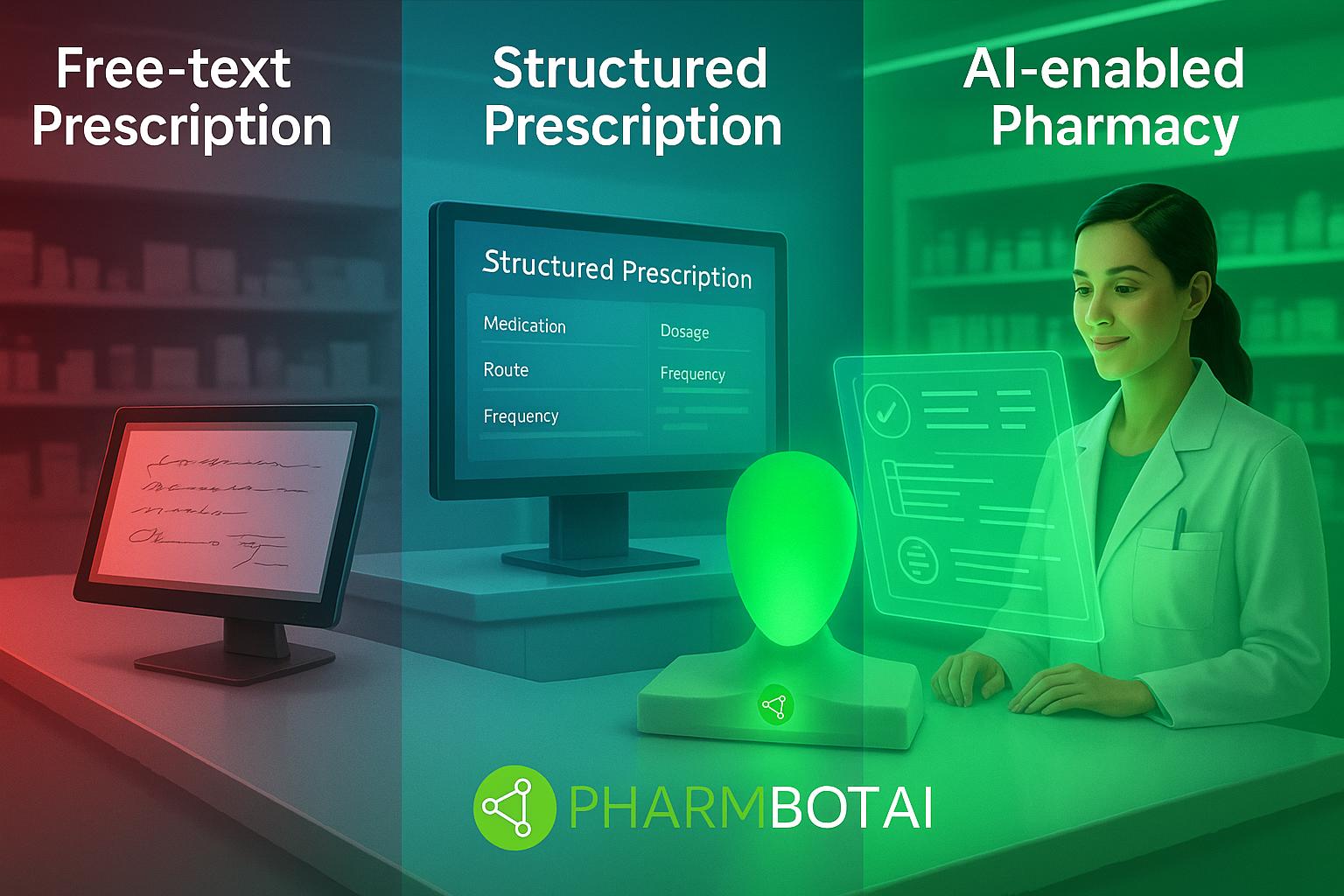
    From 2027 onwards, every U.S. pharmacy will be required to comply with new NCPDP standards, transforming how prescriptions are written and shared. On the surface, it may look like a technical update. In truth, it is a foundation shift.

    • Prescriptions will move from free-text notes to structured, machine-readable instructions
    • AI will finally have the clean, standardised data it needs to act on
    • Providers and pharmacies will be able to communicate without silos

    The goal is simple but powerful: clearer prescriptions, fewer errors, faster coordination, and AI-enabled pharmacy at scale.

    Why This Matters for Patients and Pharmacists

    Every pharmacist knows the frustration of unclear prescriptions. A missing dose instruction, a confusing abbreviation, or handwriting that leaves too much to interpretation these aren’t just inconveniences. They’re patient safety risks.

    By standardising prescriptions into structured digital formats, the U.S. is not only embracing efficiency, but also making a profound patient safety intervention. Every avoided error is a patient protected. Every minute saved is time pharmacists can reinvest in care, counselling, and clinical services.

    For the workforce, this shift means less firefighting, more care. Instead of chasing prescribers or double-checking ambiguous instructions, pharmacists will be supported by AI-driven systems that flag risks instantly. It’s about reducing the burden, protecting the workforce, and enabling pharmacy to expand its clinical role with confidence.

    The UK: Waiting or Leading?

    Here in the UK, we don’t yet have the same mandate. Structured prescription standards are not a regulatory requirement, and system interoperability remains a significant challenge.

    But that doesn’t mean we should wait until 2027 to see these benefits. In fact, waiting comes with a cost: more errors, more inefficiency, and more pressure on an already stretched workforce.

    If the U.S. can set a deadline, what’s stopping the UK from moving faster?

    Building the Foundations Now

    At PharmBot AI, we’ve been asking this very question. That’s why we’ve started laying the same digital foundations that will soon be mandated in the U.S.

    • Prescription Verification Service: Using AI to review prescriptions in real time, flagging potential risks and reducing errors before they reach patients.
    • AIVAe Platform: Providing pharmacists with structured, audit-ready support for clinical services and patient engagement.

    These tools aren’t just about compliance. They’re about future-proofing pharmacy creating an environment where pharmacists can thrive, patients can feel safer, and the NHS can deliver smarter, more coordinated care.

    Collaboration Is Key

    Technology alone will not deliver this transformation. It requires collaboration at every level:

    • Regulators creating the frameworks for safe and effective AI adoption
    • IT system providers enabling true interoperability across the NHS
    • Pharmacists co-designing and testing solutions so they reflect real practice
    • Innovators bringing forward safe, scalable AI tools with patient benefit at their core

    When these groups work together, the impact multiplies. The pharmacy of the future is not built in isolation it is co-created.

    A Vision for the Pharmacy of the Future

    So, what does this look like in practice?

    I see a pharmacy where prescriptions flow seamlessly into structured systems. AI supports pharmacists by automatically checking for interactions, verifying appropriateness, and flagging anomalies in real time. Robotics assist with dispensing. Pharmacists spend their time on what matters most, providing clinical care, supporting long-term condition management, and engaging patients in their own health.

    This is not a vision of replacement. It’s a vision of empowerment. Technology takes on the repetitive, error-prone tasks, while pharmacists step fully into their role as accessible, trusted clinical leaders in the community and across the NHS.

    The Time to Act

    The U.S. has drawn a line in the sand with its 2027 mandate. The UK has an opportunity: either wait for regulation, or act now and lead the way.

    Pharmacies that see this as a strategic upgrade, not a compliance exercise, will be the ones ready to thrive in the next era of AI-driven care.

    For patients, that means safer, faster, more consistent experiences. For pharmacists, it means more time, more impact, and more professional satisfaction. And for the NHS, it means efficiency, resilience, and a future-proofed workforce.

    The digital shift in pharmacy is already underway. The only question left is: will the UK choose to wait, or to lead?

    References

    • NCPDP (2023). SCRIPT Standard Implementation Recommendations. National Council for Prescription Drug Programs. Available at: https://www.ncpdp.org (Accessed: 18 August 2025).
    • NHS England (2021). Digital Technology Assessment Criteria (DTAC). NHS England. Available at: https://www.england.nhs.uk/digitaltechnology/ (Accessed: 18 August 2025).